One house. One clear promise.
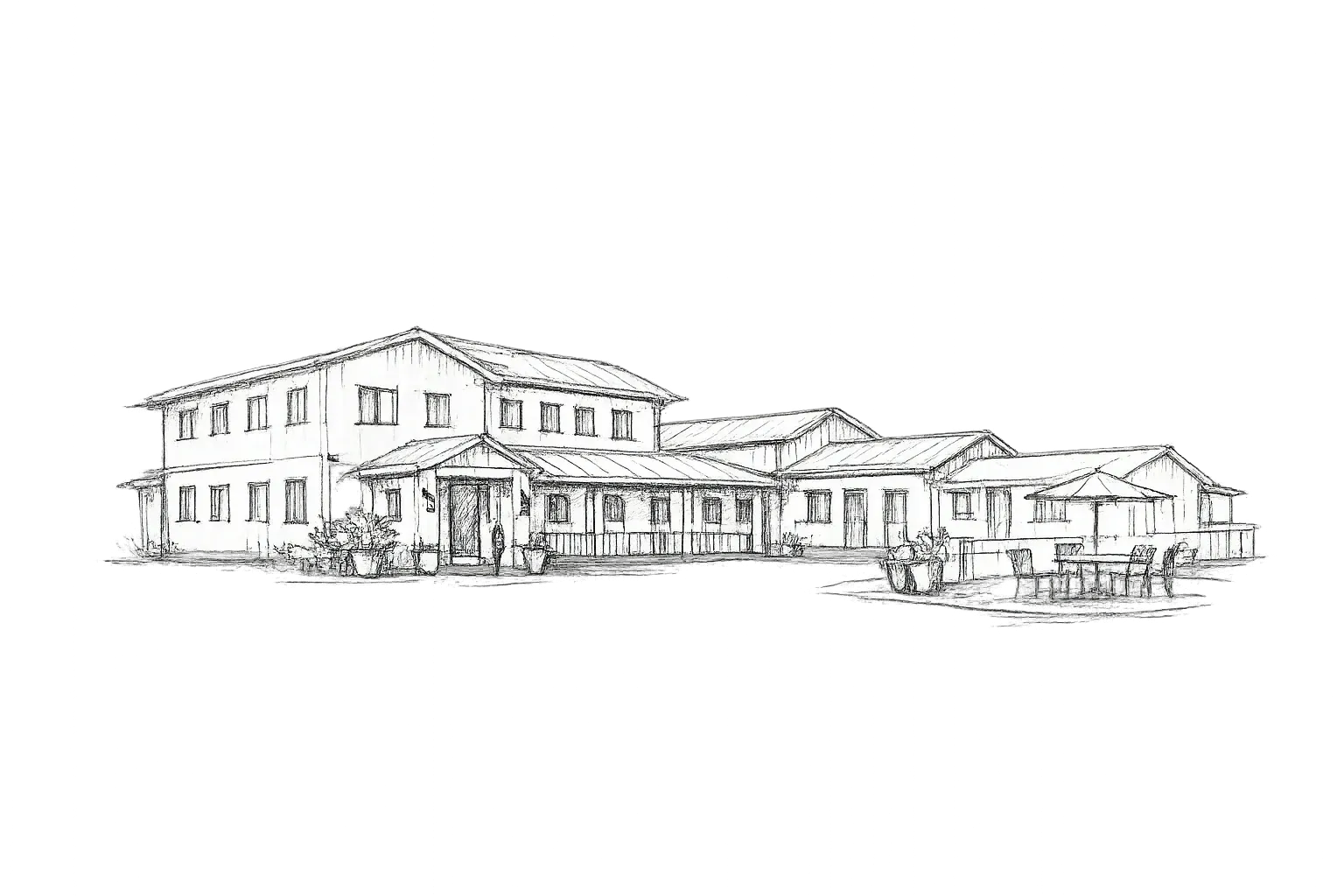
Direct booking. Clear promises. Human attention.
The owned layer between what the hotel knows and what the guest relies on.
An independent hotel already has knowledge that matters. The owner knows which room really fits a family, when a late arrival needs confirmation, whether a cot is only requestable, which access limitation matters, what breakfast includes, and which person must act when a request is not yet settled.
That knowledge often lives across the website, booking engine, inbox, WhatsApp, policy documents, staff memory, and the owner’s notebook.
Tamaga Hospitality gives the consequential parts of that knowledge a governed place to live and a clear path into the guest journey and the work before arrival.
Built for independent houses whose advantage is knowledge, care, and place.
The strongest fit is usually an owner-led or family-run property with enough operational complexity to feel the cost of fragmented information, but without a corporate digital team to solve it. Typical properties are roughly 8–30 rooms, with selective fit below or above that range when the operating reality justifies it.
Strong fit
- Room types differ meaningfully.
- International or multilingual guests matter.
- Family, access, arrival, parking, meal, transport, or cancellation questions recur.
- Direct booking matters.
- The website and booking engine feel disconnected.
- Requests are handled through email or WhatsApp.
- One owner or senior employee carries too much operational memory.
- Local partners and local knowledge materially improve the stay.
- An existing PMS or channel manager should remain in place.
Deliberate non-fit
- Enterprise chains seeking a global CRS replacement.
- Properties seeking only a visual redesign.
- Buyers seeking only a booking widget.
- Operators expecting one new product to replace accounting, POS, housekeeping, revenue management, payments, and every distribution system.
- Commodity accommodation with little interest in owned knowledge or direct relationships.
The house keeps one governed record. Each person sees what they need.
House Record
The governed foundation
The House Record is the governed record of what the property is prepared to say and deliver, including conditions, unknowns, authority, owners, and review dates.
Guest View
The direct-booking view
The guest can understand fit before availability becomes a commitment, including sleeping places, limitations, access, policies, and conditional requests in context.
Host Desk
The attention view
A conditional request can become a named item of work with a due state and a responsible person rather than another item in a general dashboard.
Channel Lens
The representation view
The hotel can inspect whether consequential meaning survives across different representations without pretending to be a channel manager.
Make the promise useful at the moment it matters.
Help the guest choose correctly
Room Fit starts with hard constraints such as proper sleeping places, occupancy, access, and bathroom configuration. Preferences come later.
Carry the promise into the stay
When a guest relies on a conditional promise, the condition should travel with the request rather than disappear at checkout.
Show the host what needs attention
Host Attention should surface exceptions that need a person instead of asking a small hotel to stare at another general dashboard all day.
Keep every version closer to truth
Tamaga can compare governed meaning with the representations a guest may encounter and identify material drift without pretending to distribute inventory.
Demonstrated first. Piloted next. AI later.
House Record / Promise Cards
Governed promise model with condition, authority, provenance, and ownership.
Room Fit
Transparent suitability evaluation independent from date inventory.
Promise-to-Task / Stay Request
Conditional guest outcome remains distinct from staff work.
Host Attention and Channel Lens
Operator attention and deterministic representation comparison in the fictional reference implementation.
Live property pilot and connectors
The next phase is a narrow managed-house pilot with connectors chosen from real property demand.
Guest Memory and Ask the House
Later capabilities follow consent, provenance, confidence, permissions, and human handoff controls.
A conditional promise should become a named action, not a forgotten note.
The house policy says: Later arrival after 20:00 requires written confirmation. A guest enters an expected arrival time of 23:30.
The room can still be chosen, the condition remains visible, a pending request is created, the guest does not see “confirmed” prematurely, and Host Attention shows the unresolved condition.
The responsible person can confirm or decline the synthetic request. The resulting state can be reflected back to the guest, while Channel Lens still distinguishes “available with confirmation” from “arrive at any time.”
The room can still be chosen.
The late-arrival condition remains visible.
A pending request is created.
The guest does not see “confirmed” prematurely.
Host Attention shows the unresolved condition.
The responsible person confirms or declines.
The resulting state can be reflected back to the guest.
Channel Lens distinguishes “available with confirmation” from “arrive at any time.”
The house should not need another opaque dependency.
Tamaga is not a replacement PMS, channel manager, payment acquirer, revenue-management system, or accounting system. The aim is an authority map, not another competing source of truth. Current implementation prices and contractual guarantees remain intentionally unpublished.