One Hotel, Seven Versions
A public-source forensic edition about how one accommodation property is represented across the modern travel web.
A public-source forensic edition about how one accommodation property is represented across the modern travel web.
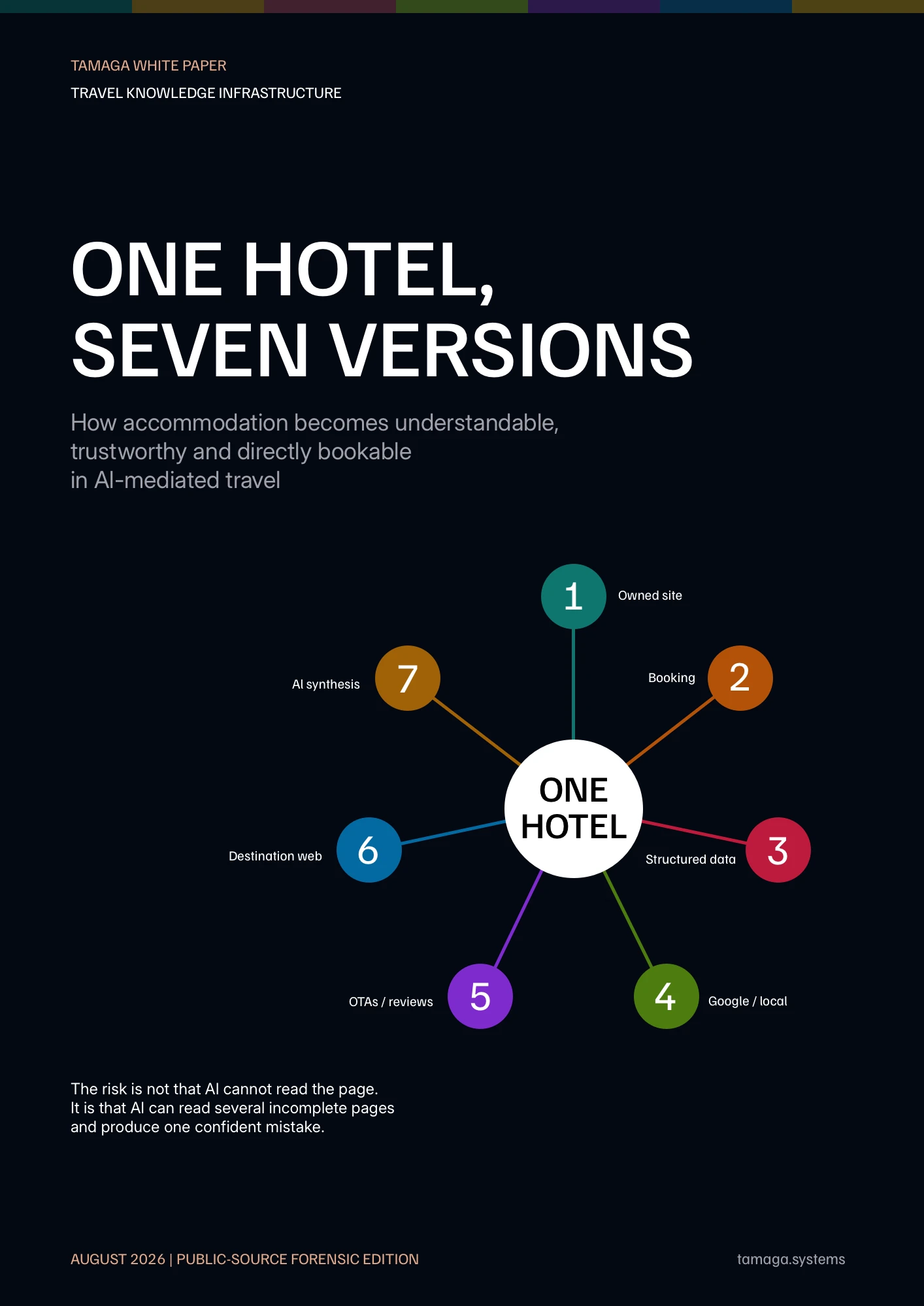
This paper examines how one accommodation property is represented across the modern travel web. It combines official platform documentation, independent and vendor research, a public-source forensic review of Hôtel Mont-Blanc Chamonix, and an independent extension of questions raised by Jean-Claude Morand and Roland Schegg. It is not an audit commissioned by the hotel, and it should not be read as an assessment of the hotel’s hospitality quality, commercial performance, legal compliance or technical implementation.
One of the seven versions studied is the JSON-LD proposal published by Jean-Claude Morand and Roland Schegg in Be Visible to AI: The Keys to Semantic Optimization and GEO (Generative Engine Optimization) for Hotels: Focus on Advanced Structured Data Strategies, version 5.1, dated August 19, 2026 and published on Zenodo August 22, 2026. That proposal is analyzed as a third-party representation of the property. It has not been verified as markup currently deployed by the hotel’s website. The AI version is likewise based on the Gemini report reproduced in that publication, generated in December 2025. AI outputs, booking interfaces, prices and policies change; every time-sensitive observation in this edition is therefore dated and bounded.
Tamaga’s editorial rule is simple: show what is sourced, show what is limited, and make corrections possible. The online Source Room accompanying a public release should carry the evidence register, figure data, methodology, corrections and version history.
This paper began as an independent extension prompted by questions raised in:
Jean-Claude Morand and Roland Schegg, Be Visible to AI: The Keys to Semantic Optimization and GEO (Generative Engine Optimization) for Hotels: Focus on Advanced Structured Data Strategies, version 5.1, August 19, 2026; published on Zenodo August 22, 2026.
Morand and Schegg argue that hotels need clearer, more coherent and better-structured information to remain understandable and visible to AI systems. Their paper uses Hôtel Mont-Blanc Chamonix as a case study and includes a proposed JSON-LD representation and a Gemini-generated family-travel report.
Version 5.1 further clarifies that structured data alone does not prevent incorrect AI output and is most effective when verified information is made available through an appropriate retrieval mechanism. Tamaga retains a separate distinction between structured expression, retrieval, source authority, synthesis and accountable action.
Tamaga extends that inquiry in a different direction. Rather than asking only whether the hotel is visible and machine-readable, this paper asks whether consequential facts retain their conditions, authority and safe action paths as they move across seven representations.
The proposed JSON-LD and reproduced Gemini report are therefore examined here as two representations of the property, not as verified live outputs of the hotel.
This is an independent Tamaga study. It was not commissioned or endorsed by Morand, Schegg, HES-SO Valais-Wallis or Hôtel Mont-Blanc Chamonix. Jean-Claude Morand provided comments on the August 2026 public edition; his participation does not imply endorsement. Responsibility for Tamaga’s method, interpretations and conclusions remains entirely with Tamaga.
Accommodation discovery is often discussed as a contest for visibility in generative search. That framing is too narrow. A property no longer exists in one digital place. It exists simultaneously in its official website, direct booking engine, structured-data layer, local-search profiles, online travel agencies, destination and editorial sources, and the synthesized answers produced by AI systems. These versions can be individually plausible and collectively inconsistent.
This white paper names that condition the Property Truth Gap: the distance between what a property can actually deliver and what travelers, search engines, intermediaries and AI systems can discover, verify and act upon. Using Hôtel Mont-Blanc Chamonix as a public-source forensic case, the paper compares 16 traveler-critical facts across seven representations. The purpose is illustrative rather than statistical: to expose where identity, room configuration, access, timing, policy and commercial facts can disappear, flatten or contradict each other.
The paper then develops two further concepts. The Omnichannel Decision Mesh extends semantic architecture beyond internal links to the wider source environment that supports a travel decision. The Source-to-Service Chain distinguishes description, entity resolution, corroboration, comparison, live offer, confirmation, action and recovery. Together, the three concepts reframe AI visibility as a knowledge-governance and service-design problem rather than a new layer of acronym-driven optimization.
The central conclusion is deliberately modest: structured data is important because it makes facts and relationships explicit. It does not make them true, current, authoritative, preferred or bookable. Durable advantage comes from agreement between the public story, structured facts, distributed sources, live offer and human service.
A hotel can be visible and still be represented incorrectly. It can appear in search, maps, an OTA, a destination guide and an AI answer while the decisive detail remains wrong: a checkout time, bed configuration, late-arrival condition, accessibility statement, seasonal facility or cancellation rule. The risk is not simply that an AI system fails to read the official page. The risk is that it reads several incomplete sources and produces one confident synthesis.
Morand and Schegg correctly identify a substantial structured-data implementation gap in hospitality. Their paper makes a useful operational case for clearer entities, coherent sources and more rigorous hotel markup. A 2026 crawl of 121,425 hotel homepages found that 36.3% of reachable sites had no structured data, while only 32.4% of the sites with JSON-LD used a lodging-specific primary type. Decision-relevant properties such as geo, aggregateRating and amenityFeature were uncommon.[5] But these findings establish an implementation problem, not a causal law of AI recommendation. A property without rich markup may still be extracted from ordinary text and third-party sources; a property with perfect syntax may still publish the wrong fact.
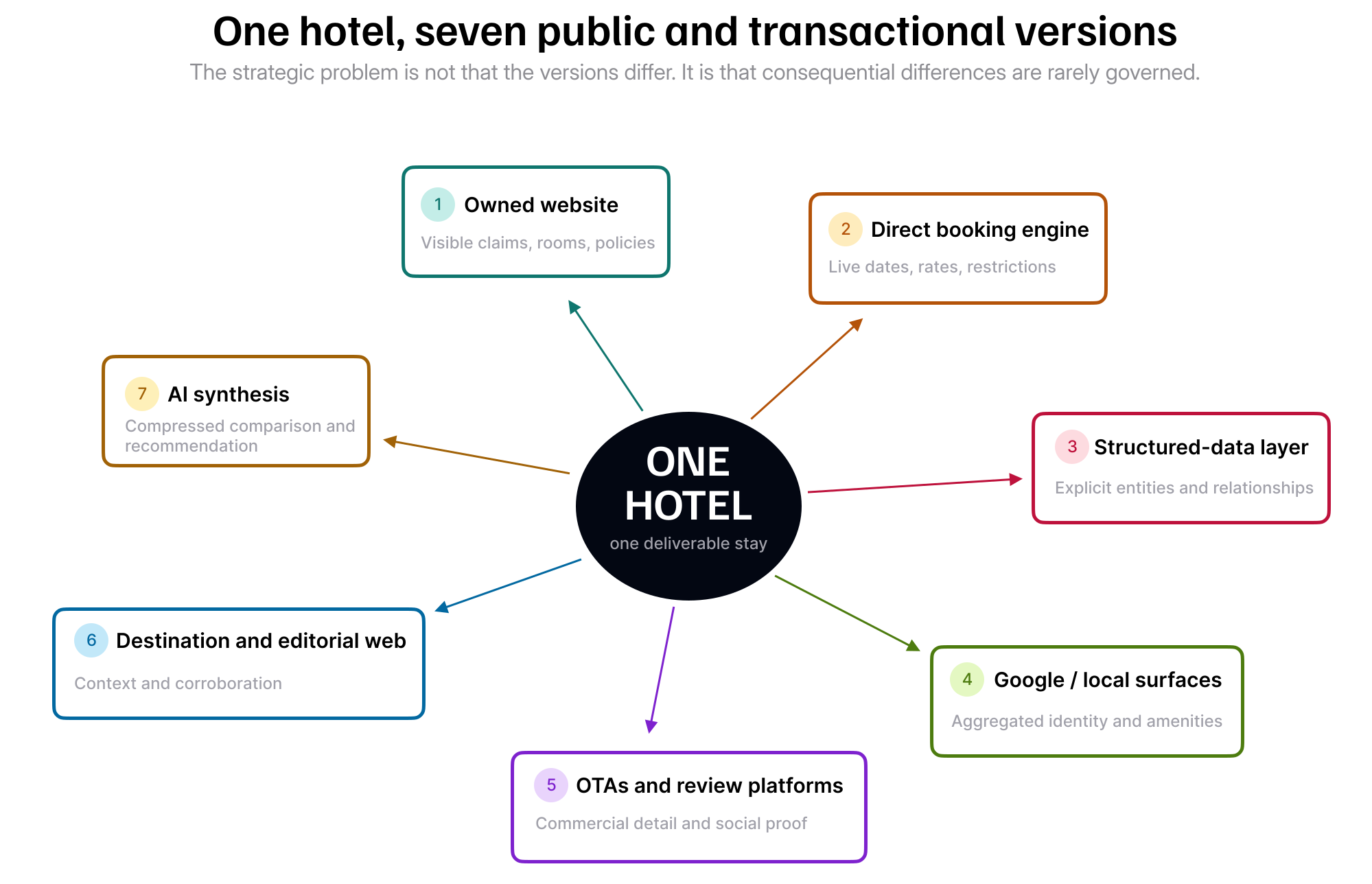
This paper separates seven versions that are often collapsed into the phrase “the hotel online”:
1. Owned website - the facts and claims a traveler can read.
2. Direct booking engine - live dates, rates, restrictions and transactional choices.
3. Structured-data layer - explicit entities and relationships expressed for machines.
4. Google and local surfaces - aggregated identity, amenities, reviews, location and prices.
5. OTAs and review platforms - commercial detail, policies, inventory and social proof.
6. Destination and editorial web - local context, independent corroboration and story.
7. AI synthesis - a compressed comparison assembled from several of the above.
Authority classes:
No version is inherently complete. The official site may contain the richest qualitative explanation but scatter it across seasonal pages. Direct and intermediary booking interfaces may each hold current commercial information while exposing different rates, restrictions, inventory or policy detail. Google may compress a nuanced access description into the label “Accessible.” An OTA may provide late-check-in conditions absent from an official FAQ. A destination office may independently confirm a spa or pool but not the room configuration. An AI system may combine all of them - and still recommend a different property.
The distance between operational reality and its public, structured, distributed and synthesized representations.
The connected set of pages, profiles, sources, partners, concepts and booking paths that allows a traveler to move from a need to a verified decision without losing meaning between channels.
The progression from describing a property to resolving it, corroborating it, comparing it, exposing a live offer, confirming consequential details, completing an action and recovering when something fails.
1. SEO did not become obsolete. Google explicitly states that existing SEO fundamentals remain foundational for its generative Search features and that no special Schema.org markup or new AI file is required.[1]
2. Structured data is a representation layer, not ground truth. It can reduce ambiguity, but syntax cannot certify a claim.
3. Accommodation must be modeled as a graph. Schema.org separates the lodging business, the accommodation unit and the offer; prices and conditions belong to the offer rather than to the abstract hotel or room.[4]
4. Different facts move at different speeds. An address may be stable for years; restaurant opening, inventory, prices and reservation state require different systems and update frequencies.
5. The wider web matters. Large-scale observational research shows that AI hotel answers draw heavily on OTAs, review platforms, brand sites, Wikipedia, social sources and editorial domains, with substantial differences between models.[6]
6. Citation is not recommendation, and recommendation is not booking. Measurement must distinguish entity resolution, candidate inclusion, factual accuracy, link destination, live offer and completed action.
7. Direct booking is not automatically better. OTAs provide reach, comparison, trust, payment and support. Direct channels create value when they offer parity, clarity, distinctive service and an accountable relationship.
8. AI may disintermediate or reintermediate. A conversational interface can send a traveler directly to a property, or it can route the entire transaction through a connected intermediary.
9. Agent tools do not guarantee agent use. An API or MCP tool must still be discovered, selected, called correctly, authorized, confirmed and recoverable.[14]
10. The durable advantage is agreement. The property, page, markup, platform, offer and team should describe the same stay.
Do not begin with an AI content factory or a custom agent. Begin with one decision-critical fact - for example late arrival, connecting rooms, step-free access or cancellation - and trace it through all seven versions. Identify the owner, source, conditions and update path. Then repeat.
The implementation sequence in this paper is:
Align the facts. Prove the consequential claims. Distribute coherent representations. Connect live operational truth. Act safely with confirmation and recovery.
The white paper uses four evidence labels.
ESTABLISHED - supported by official specifications, stable documentation or strong peer-reviewed evidence.
OBSERVED - supported by a documented dataset or public-source audit, but not necessarily causal or generalizable.
ILLUSTRATIVE - a case observation used to expose a mechanism, not a sector-wide estimate.
UNKNOWN - a plausible relationship for which current public evidence is insufficient.
The supplied preliminary papers are treated as research inputs. Their statistics and technical examples are retained only where the original source can be identified or the paper itself is the object of analysis. Unsupported claims - such as the idea that JSON-LD automatically improves recommendations - are not silently carried forward.
PROLOGUE
A traveler asks:
Find a quiet independent hotel in Chamonix for two adults and two children in late October. We arrive by train after 20:00 on Sunday. We need two connecting rooms, step-free access, dinner that evening and flexible cancellation. Compare the direct offer with an OTA, identify what is confirmed, and tell us what still requires a human. The answer engine has enough material to sound decisive. It finds a five-star hotel in the center of Chamonix. It reads that Standard and Superior rooms can connect. It sees an outdoor heated pool, a restaurant, a shuttle, parking and a spa. It sees a 24/7 reception label on some room pages. It finds policies and fees on an OTA. It finds the pool and spa independently described by the destination office. It may even find a long-form report that frames the hotel as a strong urban alternative for a family.
A fluent answer might therefore say:
Hôtel Mont-Blanc is a strong fit. Book connected Standard and Superior rooms, arrive at any time, dine at Le Matafan on Sunday evening, and use the hotel’s step-free facilities. The outdoor pool is heated year-round. Book direct for the best service and flexible cancellation. Every sentence is plausible. Not every sentence is established.
The official room pages say communicating rooms are available on request, not guaranteed.[20] The official materials reviewed confirm a reception service and the standard check-in time, but the OTA is the source that explicitly frames check-in as 15:00 to midnight and late check-in as subject to availability.[27] The official restaurant material reviewed makes Sunday lunch explicit, but does not by itself guarantee a late Sunday dinner for the traveler’s dates. The destination office confirms a spa open every day and an outdoor heated pool, yet that does not prove the exact October operating conditions of every associated service.[29] Google compresses access into the generic label “Accessible,” while the hotel’s own information is more specific: two Prestige rooms are adapted for guests with reduced mobility.[20]
The answer is not necessarily false. It is underqualified. It turns several kinds of evidence into one promise.
That is the central failure examined in this paper.
AI did not create the contradiction. It exposed a representation system in which:
The problem is not merely visibility. It is the integrity of the path from source to service.
CHAPTER 1
Hôtel Mont-Blanc Chamonix is useful as an illustrative case because it is not digitally absent. It has a substantial official website, room-category pages, seasonal practical information, a direct booking application, Google Hotels representation, major OTA listings, destination-office pages, editorial coverage and an existing AI report reproduced in the Morand-Schegg paper. In other words, it has the kind of distributed public footprint that many “AI visibility” guides tell hotels to build.
The question is not whether the hotel exists online. The question is whether the versions agree where the traveler needs certainty.
This is a public-source study. It does not claim access to the hotel’s PMS, CRS, internal accessibility documentation, current markup deployment, private booking rules or staff procedures. Where operational confirmation is unavailable, the paper says so.
The owned site is the richest first-party narrative. It describes room size, occupancy, beds, views, services and facilities. The Standard room page states that a Standard and Superior room can connect and labels communicating rooms as available on request.[20] The Duplex Suite page states four-person occupancy, 75 square meters and two king-size beds.[21] Current practical information gives 15:00 check-in, 11:00 checkout, parking and electric-vehicle fees, pet conditions and adapted Prestige rooms.[19]
The official site also demonstrates a common structural problem: the truth is distributed across page families and seasons. A traveler may need to combine a room page, winter practical information, a spa page, a restaurant page and booking-engine output. The website knows much more than any one page proves.
The direct booking path is not merely another page. It is where dates, occupancy, availability, rate plans, payment conditions and cancellation choices should become transactional. In the text-only public audit, the engine was delivered through a JavaScript application and its live contents could not be fully inspected. That limitation is important.
“Not observable to this audit” does not mean “not available to the traveler.” It means the booking engine is a separate representation surface with different access, rendering and update mechanisms. A crawler, browser-based agent, mobile user and human researcher may not see the same thing.
The direct engine should therefore be treated as its own version, not assumed to inherit the official site’s content or structured data.
The Morand-Schegg paper presents a proposed JSON-LD block as a state-of-the-art representation for the hotel.[32] It is a useful demonstration of both the power and danger of structured data.
The proposal correctly attempts to create explicit entities and relationships: hotel, Suite Duplex, restaurant, address, coordinates, facilities and occupancy. But it also contains consequential errors or ambiguities:
The proposed code is machine-readable. That is exactly why the errors matter. Structured data can turn ambiguity into explicitness. It can also turn an uncertain or incorrect statement into an explicit, reusable error. Every consequential semantic definition and value therefore needs a named business owner who can verify its meaning, resolve conflicts and authorize correction.
Google Hotels combines the property identity, location, review-derived themes, amenities, prices and links from multiple sources. Its current listing states check-in at 15:00 and checkout at 11:00. It shows pool, spa, hot tub, restaurant, shuttle, paid parking, pet-friendly and the generic label “Accessible.” Google itself notes that it collects hotel amenities from a variety of sources.[26]
That aggregation is convenient for comparison. It is also lossy. “Accessible” does not tell a traveler whether the entrance, reception, lift, bedroom, bathroom, restaurant and route from the station are step-free. The local surface is a powerful candidate-selection interface, not a complete accessibility statement.
OTAs often carry operationally useful detail because they need to support booking decisions and customer service. Expedia currently states 15:00 to midnight check-in, late check-in subject to availability, checkout before 11:00, dogs at EUR 25 per night and city tax conditions.[28] Other OTA representations may vary by market, translation and inventory source.
This version can be more explicit than the official site on some policies while being less nuanced on room fit or service context. It also has a commercial incentive and a customer-support obligation that editorial sources do not.
The Chamonix destination site independently describes the 250-square-meter Clarins spa, a heated pool and outdoor whirlpool, an age minimum of six and daily opening.[29] Editorial guides and specialist travel sources may add heritage, restaurant, location and experience context.
These sources are valuable because they can corroborate and contextualize. They are not necessarily current systems of record for room availability, rate conditions or late arrival. Their authority is claim-specific.
The Gemini report reproduced in the Morand-Schegg paper is a vivid example of cross-source synthesis.[31] For a family seeking luxury, food, a heated outdoor pool and ski access, it recommended Hameau Albert 1er as the primary choice and presented Hôtel Mont-Blanc as an urban alternative. It successfully extracted connected-room information, pool, spa, shuttle, restaurant and location context from ordinary pages and third-party sources.
That appendix undermines the strongest claim made elsewhere in the same paper: that an AI will leave empty-handed without structured data. The AI clearly found and combined substantial information. But it also illustrates a second truth: extraction is not preference. A hotel can be understood and still lose the recommendation.
The seven versions should not be forced into identical copies. Each has a role:
The governance objective is not uniform text. It is agreement on consequential facts, visible ownership of uncertainty and a safe handoff to the system or person capable of confirmation.
CHAPTER 2
The Property Truth Gap is the distance between what an accommodation provider can actually deliver and what its public, structured, distributed and synthesized representations allow a traveler or machine to conclude.
The gap has four forms:
Absence - a decision-critical fact exists internally but is not publicly available.
Flattening - a nuanced condition becomes a generic label, such as “accessible” or “family-friendly.”
Contradiction - two versions publish incompatible values.
Action failure - the information is understandable, but no safe route exists to confirm, book, modify or recover.
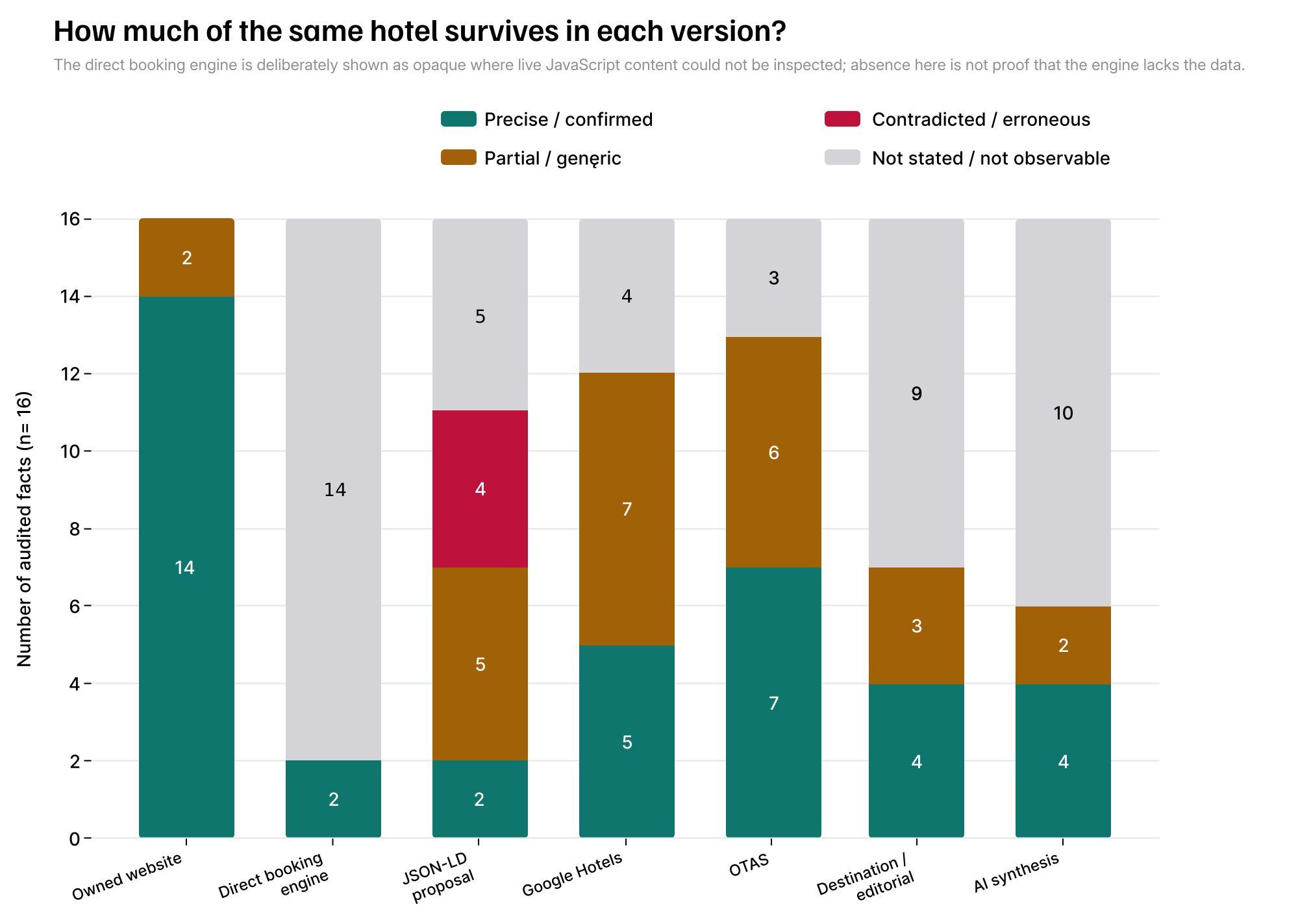
Sixteen traveler-critical facts were reviewed across the seven versions. Each observation was coded as:
This is not a rating of the hotel. It is a representation map based on public evidence available to the research process in July 2026. The booking engine’s live contents, for example, were not fully observable in the text-only audit, so absence in that column is a limitation rather than a claim that the engine lacks the data.
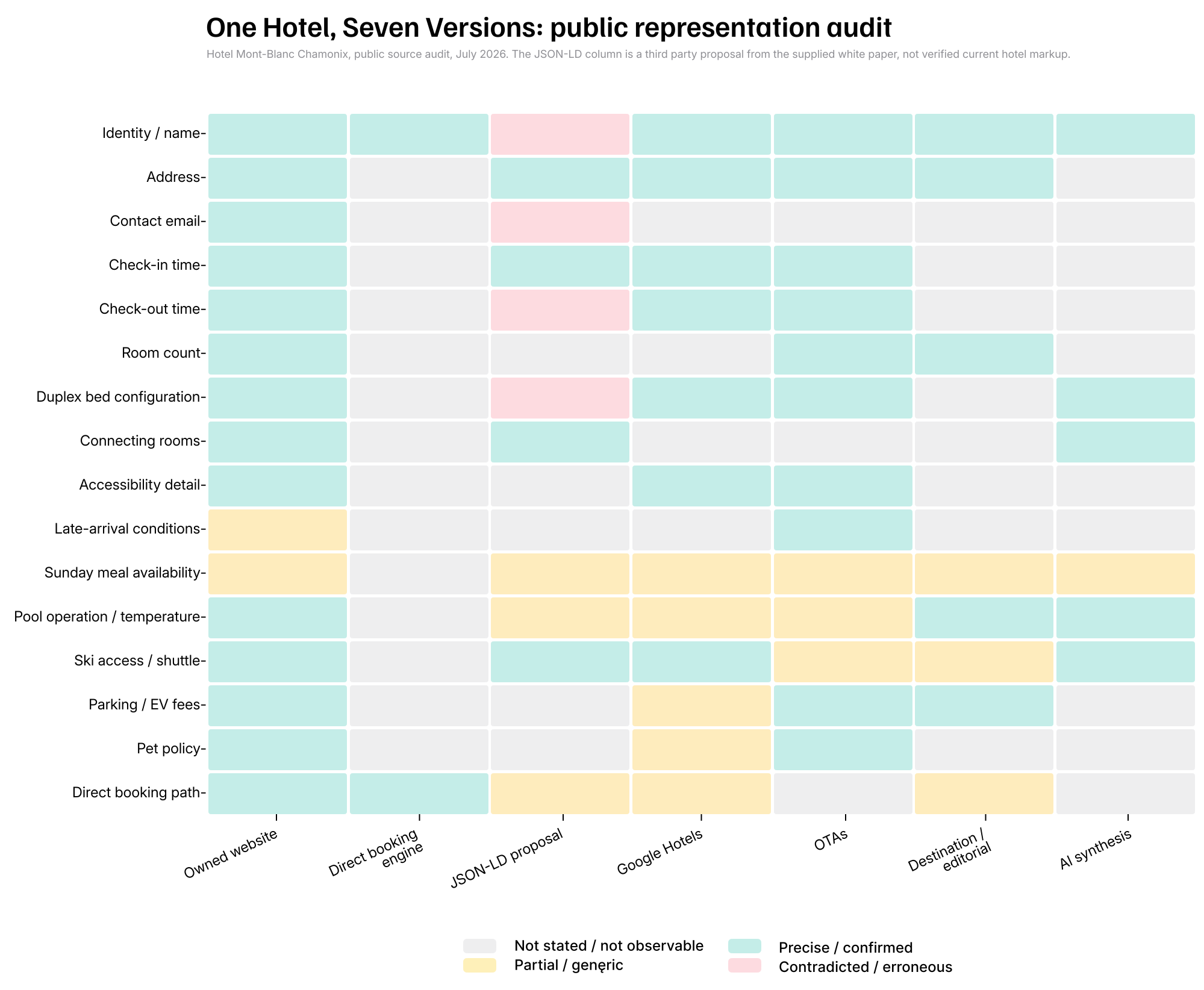
The official site is the strongest public source for many stable and experiential facts. It is precise on identity, address, contact, room occupancy, the Duplex bed configuration, communicating rooms, parking, pet policy and direct booking. Yet some decision details remain fragmented or conditional: communicating rooms are on request; Sunday lunch does not establish late dinner; an adapted room does not answer the entire step-free journey.
The direct booking engine is central to commercial truth but comparatively opaque to a static text audit. This is not a defect unique to the case. Modern booking applications often require dates, scripts, cookies, inventory calls and user interaction. Their truth is dynamic by design.
The JSON-LD proposal contains the highest concentration of outright contradictions. This is analytically useful because it shows how easy it is to build an impressive graph from imperfect research. The problem is not JSON-LD. The problem is separating authoring convenience from fact governance.
Google and OTAs cover broad decision needs but often compress meaning. They are strong on check-in, checkout, amenities, fees and commercial conditions. They are weaker at distinguishing “available” from “guaranteed,” or broad access labels from precise pathways.
Destination and editorial sources are strongest where independent context matters: spa description, location, reputation and local positioning. The AI synthesis is broad but selective. It extracts enough to compare the hotel, yet does not expose every uncertainty in the underlying sources.
Identity errors are visible and easy to correct. Conditional facts are harder:
These facts combine a noun with a condition. Generic markup and generic content tend to preserve the noun and lose the condition.
When versions disagree, the underlying cause is rarely “bad AI.” It may be:
The gap therefore measures the distance between expertise and infrastructure. It should be treated as a governance problem before it becomes a marketing problem.
For every consequential fact, maintain:
For a small property, this can begin as a spreadsheet. The value comes from ownership and propagation, not from software complexity.
CHAPTER 3
Generative answer surfaces compress the number of visible candidates and synthesize information across sources. They can answer longer, constraint-rich questions without requiring a traveler to open ten tabs. This is a real interface change.
It is not a clean replacement of SEO by GEO. Google states that specific optimization is not required for AI Overviews and AI Mode, that existing SEO fundamentals remain worthwhile, and that websites do not need a special AI file or special Schema.org markup.[1] Crawling, internal links, visible text, page experience, accurate structured data, images, video, Business Profile and Merchant Center data remain part of the same system.
OpenAI likewise describes search visibility in terms of public accessibility and OAI-SearchBot access rather than a proprietary GEO schema.[3]
The useful distinction is not SEO versus GEO. It is between:
A large observational study of 19,579 AI hotel-recommendation runs found that models used markedly different source mixes.[6] In GPT-5.2 runs, Booking.com appeared in 53.9%, Hotels.com in 31.9%, Marriott.com in 30.6%, Wikipedia in 30.0%, Expedia in 28.9% and Tripadvisor in 20.5%. Grok and Perplexity showed very different dependencies.
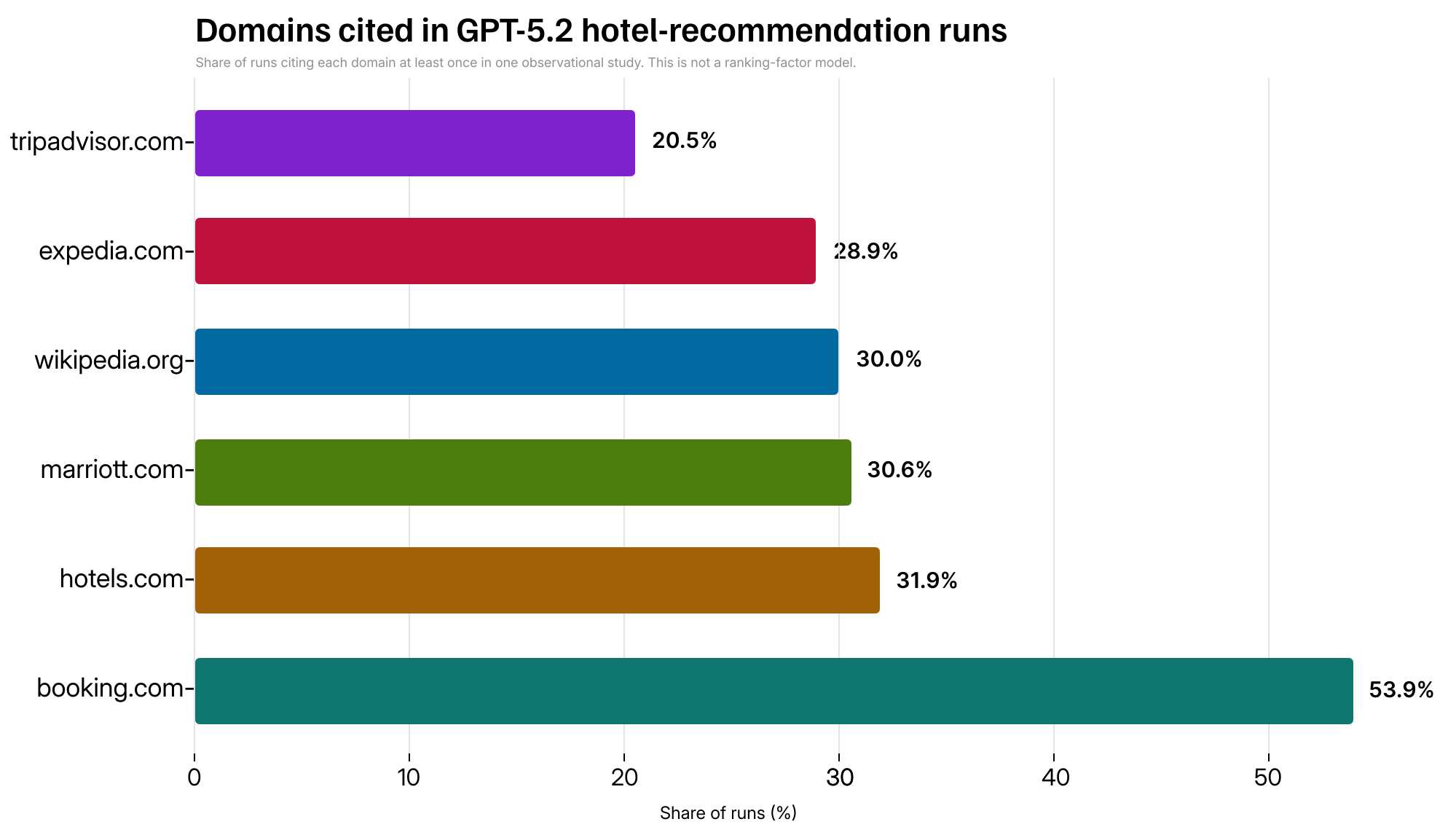
These figures should not be interpreted as ranking factors. They show that:
The same study reported that 75% to 91% of hotel links in its model outputs pointed to hotel-owned domains even though OTAs were heavily consulted. That finding suggests a direct-referral opportunity, but it does not guarantee that a hotel will be selected or that a direct booking will follow. Heavy consultation of OTAs does not create an unavoidable dependency: the defensible response is stronger hotel-authorized information, clearer source authority and independent corroboration across the wider travel web.
Pew Research Center analyzed 68,879 Google searches from 900 U.S. adults. Users clicked a traditional result in 8% of visits when an AI summary appeared, versus 15% without one; links inside the summary were clicked in 1% of such visits.[7]
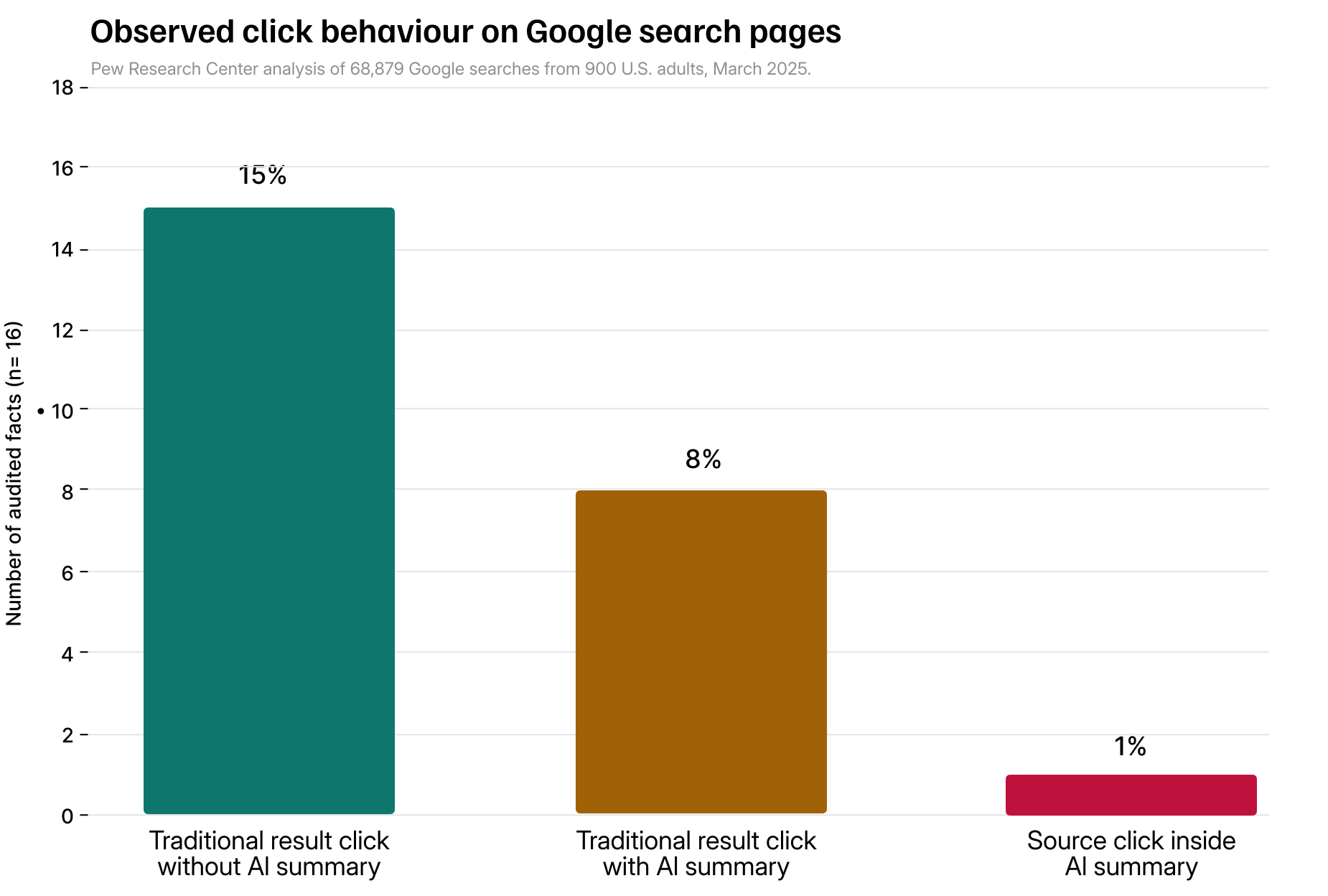
The evidence is specific to the study period, population and Google interface. It does not mean every travel query becomes zero-click. It does mean that a property should evaluate representation inside the answer as well as referral traffic after it.
Adobe’s analysis of more than eight million visits to U.S. travel sites found AI-source traffic up 194% year over year in May 2026 and 2,215% since October 2024, while conversion remained 28% below non-AI traffic but the gap had narrowed substantially.[8] The absolute share remains much smaller than search for most sites. The rational response is measurement, not panic: hotels should track qualified referrals, conversion, booking value or revenue, distribution cost and contribution rather than treating click-through rate as the outcome.
The 2026 hotel schema crawl provides the strongest public baseline currently available.[5]
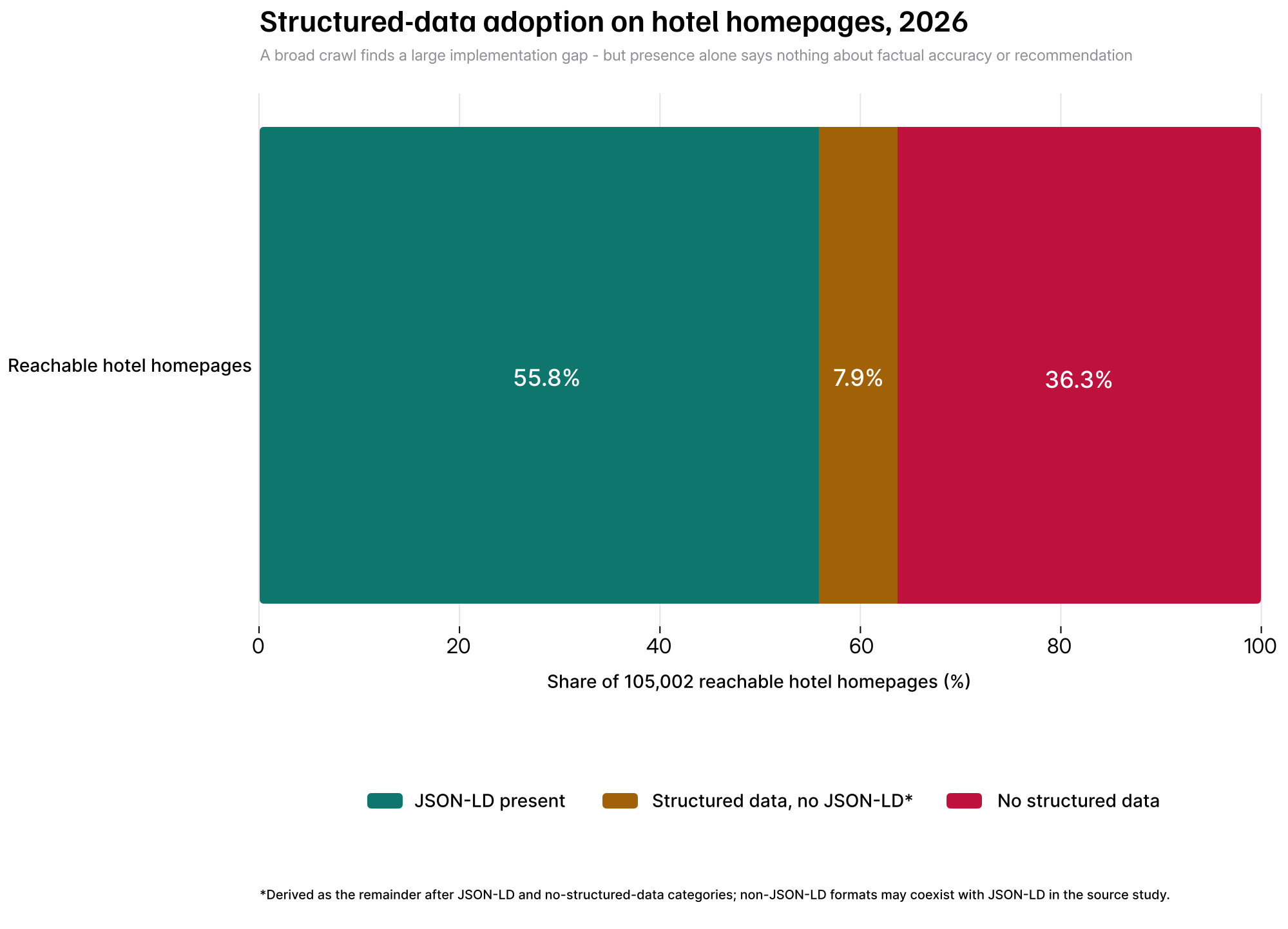
Among 105,002 reachable homepages, 55.8% contained JSON-LD and 36.3% contained no structured data. The remainder used only other formats or fell outside those two categories.
Among JSON-LD implementations, Organization was more common as the primary type than Hotel. Only 32.4% used a lodging-specific primary type.
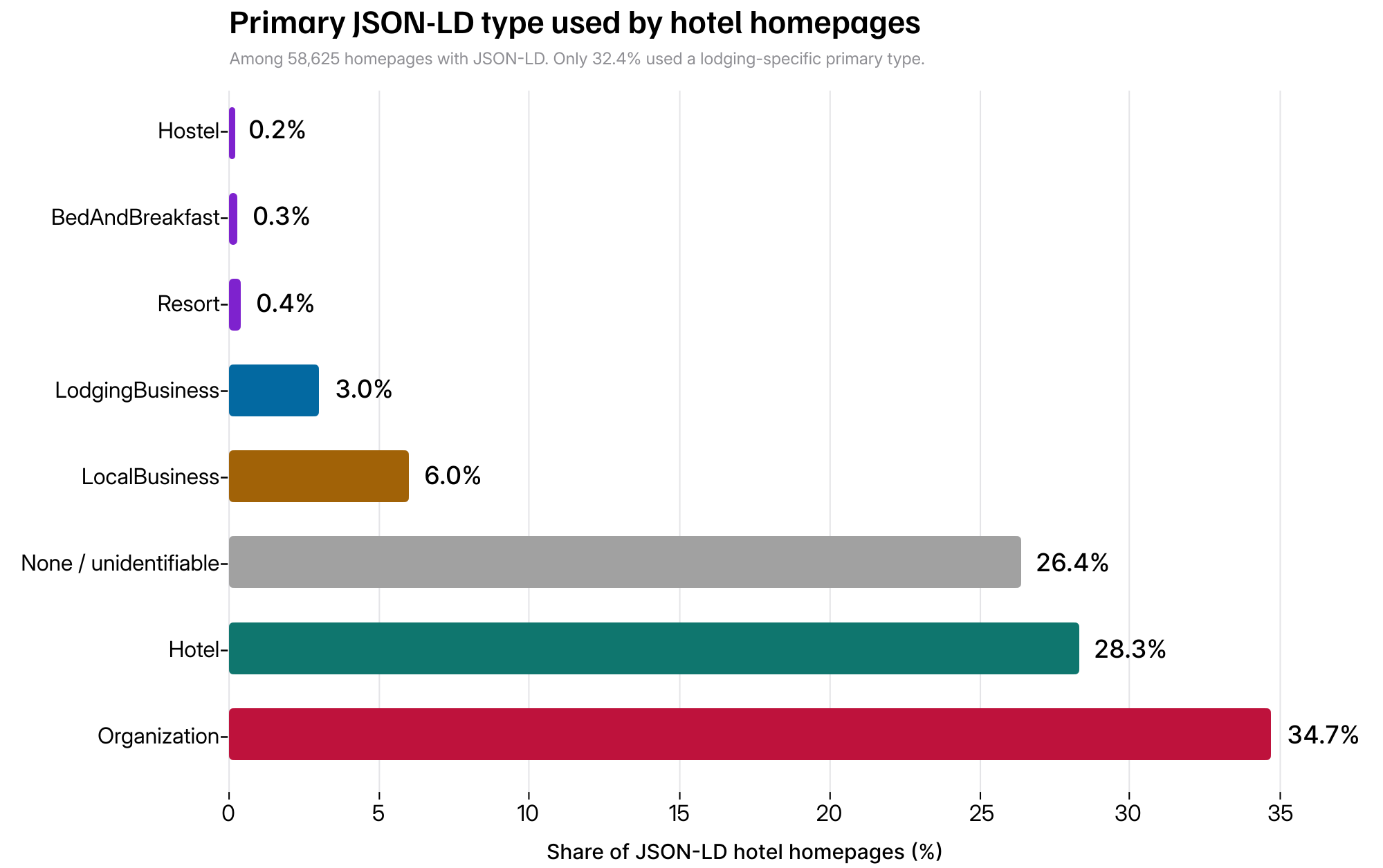
The most frequently present field was name at 71%. More decision-relevant fields were much rarer: among hotel homepages with JSON-LD, amenityFeature appeared on 7.7% and starRating on 10.0%.[5]
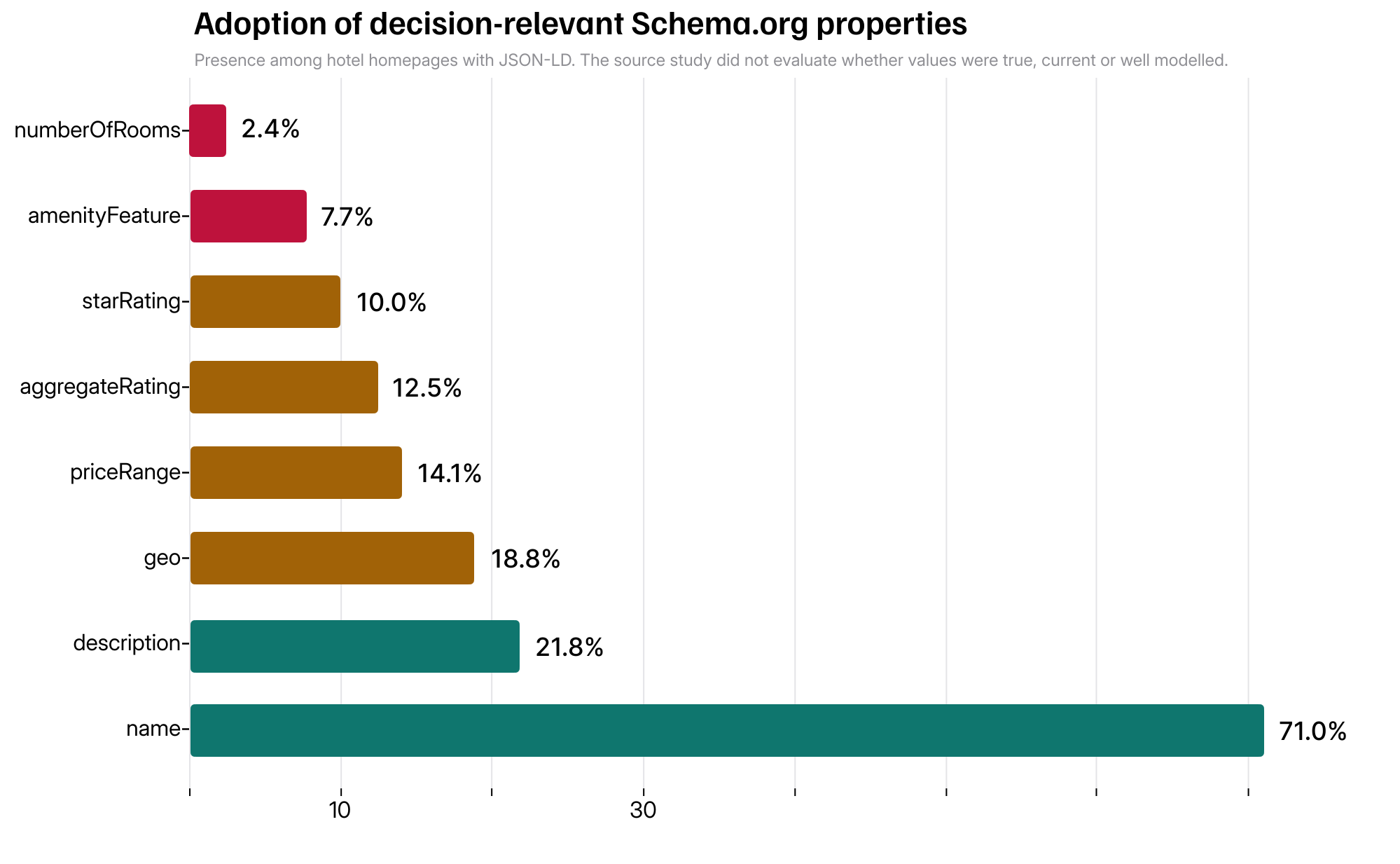
The study’s custom completeness score evaluates field presence, not truth, freshness or correct relationships. The right conclusion is therefore:
Hospitality has a large machine-representation gap. The wrong conclusion is:
The missing fields prove that those hotels cannot be understood or recommended by AI.
A traveler asks for “a quiet hotel for an older parent near the station with dinner on Sunday.” The answer may depend on:
Schema.org can express pieces of this. It cannot perform the entire judgment, and many of the most useful signals are conditional, qualitative or external.
A hotel may have:
Reducing these into one “AI visibility score” conceals the problem that needs repair. Chapter 11 proposes a multidimensional measurement model.
CHAPTER 4
Structured data is valuable because it makes a publisher’s claims explicit. It can:
These benefits existed before generative AI. The new interfaces increase their strategic relevance because more systems now synthesize information across sources.
Structured data cannot independently establish:
A false checkout time remains false inside JSON-LD. A stale price remains stale. A property can correctly state that it has adapted rooms without proving that a particular traveler can independently navigate every part of the stay. The relevant systems are complementary: Schema.org describes public entities and relationships; OpenTravel provides travel transaction and message semantics; PMS, CRS and channel managers hold or propagate operational state; a governed House Record retains meaning, provenance, conditions and ownership; and responsible people confirm consequential exceptions. Standards and APIs do not by themselves prove that an autonomous agent can act safely.
Does the JSON parse? Are the types and properties recognized?
Is the entity modeled correctly? Does an offer point to a room? Is a ski room being incorrectly typed as a ski resort? Does the property belong at hotel level or room level?
Does the value match visible content and current operational reality? Who owns it? When was it checked? Under which conditions does it apply?
Validators are strongest at the first layer. Human and operational governance are necessary for the third.
Google explicitly advises that structured data should match visible text.[1] This is not only a policy issue. Parity allows:
The worst structured-data implementations are hand-authored shadow websites: detailed hidden blocks that are more ambitious than the page and disconnected from the CMS.
A stable @id allows entities to be referenced consistently across pages. For example:
The identifier should persist even when the visual template changes. Names, URLs, languages and channel listings can then be mapped to the same conceptual object.
sameAs should identify pages that unambiguously represent the same entity. It should not be used to attach every mention, directory or partner. An OTA property page may be an identity reference, but editorial articles and review pages usually have different roles. Treating all external links as equivalent erases the distinction between identity, corroboration and commentary.
aggregateRating is frequently recommended because it appears decision-relevant and is rare in the crawl. But a publisher should not simply copy a third-party rating into owned markup without satisfying platform policies and clearly establishing the source. A rating is not just a number; it has a population, date, scale and owner.
Hotels should publish clear answers to genuine questions. That is good content and service design. It does not follow that FAQPage markup is an AI ranking tactic. Google has substantially restricted FAQ rich-result eligibility, and its generative Search guidance says no special markup is needed.[1]
The best question page is one that exposes a maintained operational answer, not one manufactured to increase schema count.
Structured data should be positioned as:
a public interface to a governed knowledge model. Not as:
a machine-readable spell that makes the hotel recommendable.
CHAPTER 5
Schema.org’s hotel guidance identifies three core objects:[4]
1. the lodging business;
2. the accommodation unit;
3. the offer to rent that unit under particular terms.
This distinction is essential because travelers do not book an abstract hotel. They book a dated right to use a particular category of accommodation under a particular policy.
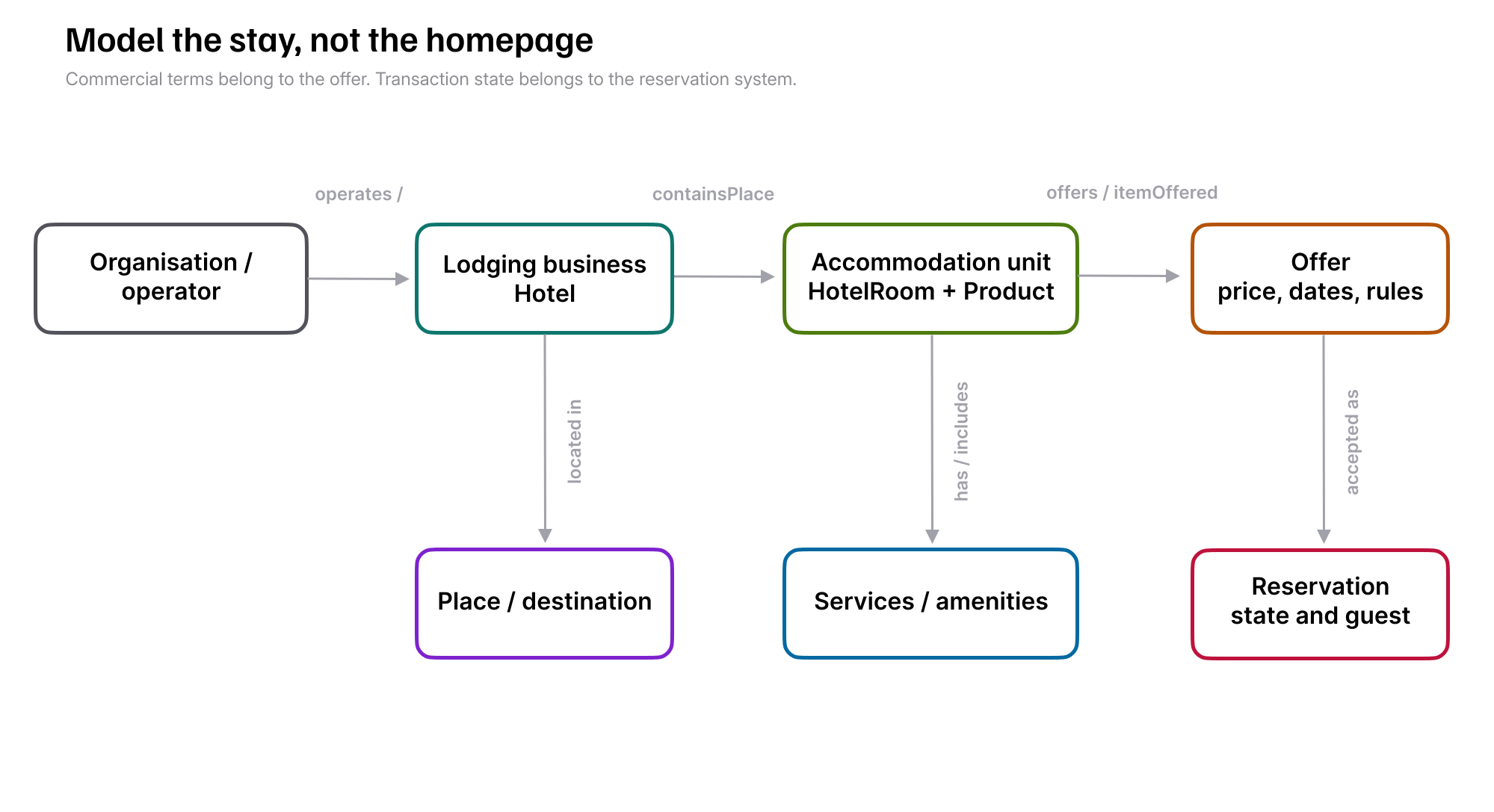
The property entity can carry relatively stable facts:
Use the most specific applicable type - for example Hotel, Resort, Hostel or BedAndBreakfast - rather than treating Organization as the complete representation.
A room or suite should be its own entity when it has a meaningful category page or bookable identity. It can carry:
Schema.org uses multi-typed entities so that a HotelRoom can also be a Product when it is the item offered commercially.[4]
Prices, validity and commercial conditions belong to the Offer, not to the room as an eternal fact. The offer can represent:
Google’s hotel pricing systems are specialized and separate property content from live price and inventory mechanisms.[12][13] Static website markup should not be used as a fragile substitute for a live rate feed or booking engine.
A reservation is transaction state:
This state belongs in authenticated systems. It should not be exposed as public structured data simply because a public vocabulary exists.
A common error is putting everything at hotel level.
Property level: outdoor pool, parking, restaurant, spa, address.
Room level: two king-size beds, 75 square meters, private sauna, communicating-room relationship.
Offer level: breakfast included, refundable until a date, minimum stay, member price.
Reservation level: room allocated, late arrival noted, payment received.
The level determines what can safely be inferred. “The hotel has connecting rooms” is not equivalent to “this booking guarantees two connecting rooms.”
Accommodation data needs a status vocabulary more precise than a Boolean.
This status may need to live in the content model even when Schema.org lacks a perfect property. The visible page should explain it, and an agent should not silently upgrade request-only to guaranteed.
Appendix B provides an illustrative JSON-LD pattern for the case property. It deliberately omits live prices and availability because those values should be generated from the current commercial system. The example uses:
The point is not to maximize field count. It is to make every public claim defensible.
CHAPTER 6
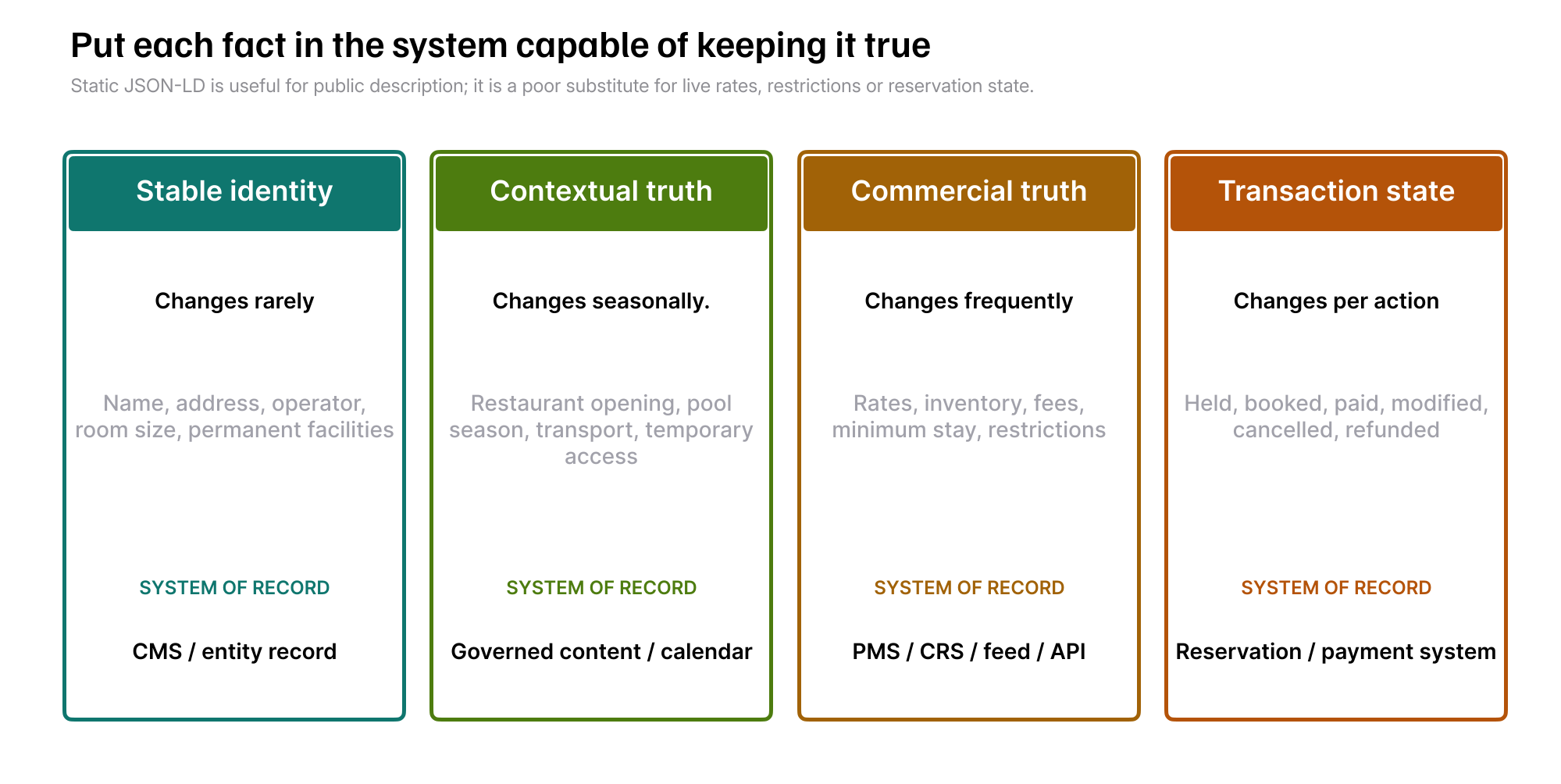
Travel facts do not all age at the same rate. Governance should begin by matching each fact to its volatility and system of record.
Examples:
Best home:
Review when the property changes or at a scheduled low frequency.
Examples:
Best home:
A generic amenity field is rarely enough.
Examples:
Best home:
These values should not depend on manual edits to a static page or JSON-LD block.
Examples:
Best home:
A hotel rarely has one database that can authoritatively maintain every fact. “Single source of truth” is therefore better interpreted as:
The property CMS may own room descriptions; the PMS may own inventory; the CRS may own rate plans; the front office may own late-arrival exceptions; the DMO may own local event records.
When checkout changes from 12:00 to 11:00, the work is not complete when the official page changes. The organization should know whether the update reaches:
A fact without a propagation map becomes tomorrow’s contradiction. PMS and channel managers can improve propagation, but they do not become independent sources of truth merely by distributing a value: the originating authority, precedence and correction path must remain explicit.
Travel facts can change strength in translation. “Accessible rooms” may become “fully accessible hotel.” “Connecting rooms on request” may become “connecting rooms available.” “Dogs welcome” may become “pets allowed.” Controlled concepts and named review are therefore operational requirements, not editorial niceties.
CHAPTER 7
Laurent Bourrelly’s Semantic Cocoon is a practitioner method built around audience analysis, search intent, offer-demand alignment, site architecture and deliberate internal linking.[15] Its useful contribution is not a secret LLM factor. It is the insistence that content architecture should begin with the user’s intended outcome rather than with a pile of page formats.
His more recent omnichannel framing extends coherent authority across web pages, video, audio, newsletters and social channels.[16] Again, the relevant insight is architectural: a subject is represented across an ecosystem.
Christian Méline’s Metawords work treats a subject as a semantic fingerprint rather than a keyword or synonym list, and emphasizes intention, lexical relationships and semantic continuity between pages.[17][18]
The Omnichannel Decision Mesh is a travel-specific extension inspired by these methods. It does not claim that either method is a proven LLM ranking mechanism.
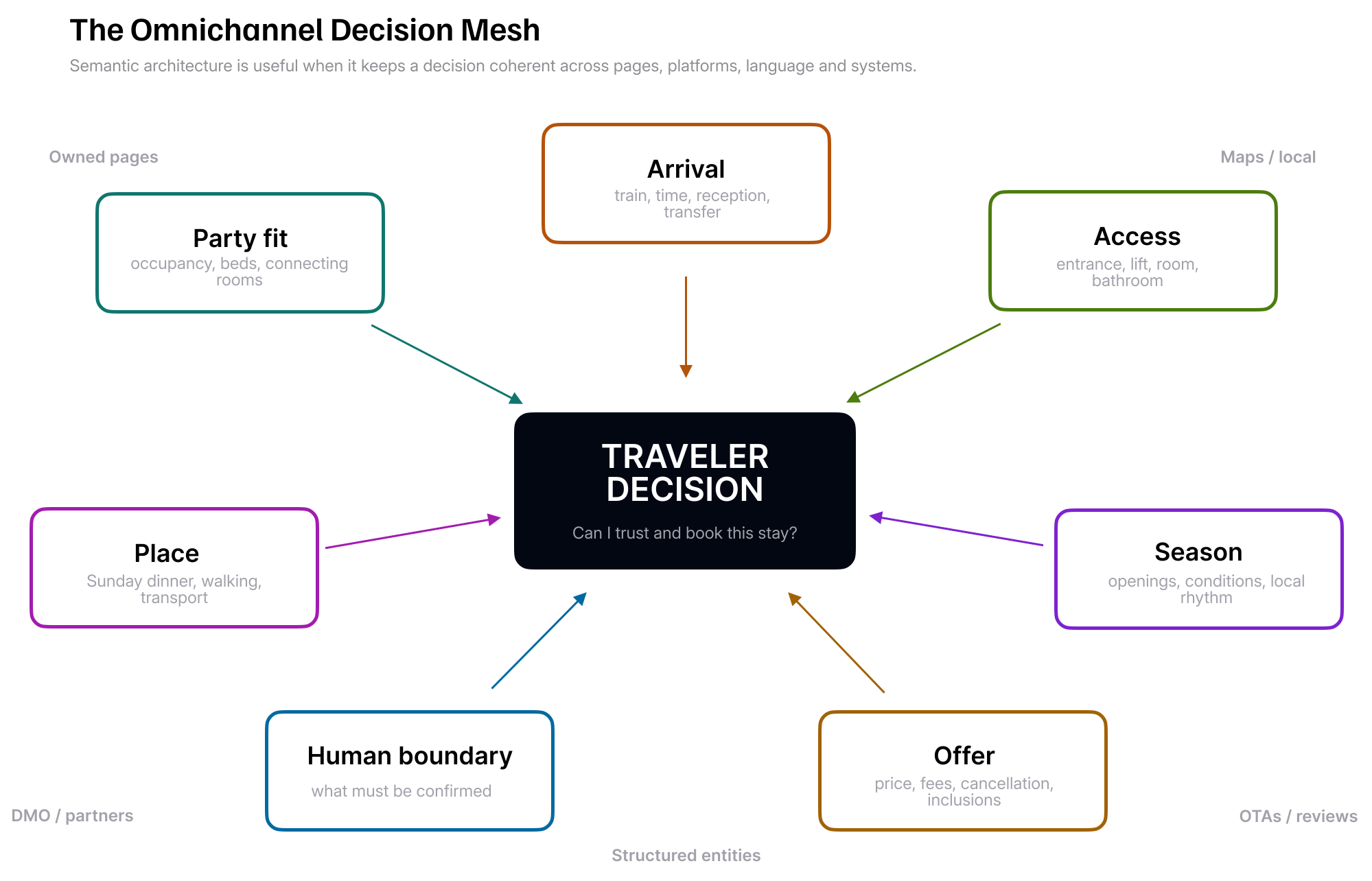
The mesh begins with a decision:
Can I trust and book this stay for this traveler, date, route and constraint? It connects six practical dimensions:
The human boundary is part of the mesh: which detail still requires confirmation?
A useful internal link should move the traveler to the next unresolved question.
Examples:
“Learn more” is not a decision transition.
The mesh also includes external nodes:
The goal is not duplicate text. The goal is semantic and factual continuity. A destination office can provide local context; the hotel should provide room truth; the OTA can provide bookable policy; the transport operator owns the schedule.
A keyword is a query expression. A governed concept is a maintained piece of meaning. Stable, reusable concepts may justify additions to shared vocabularies such as Schema.org, but industry standardization does not remove the need for named business ownership of each property’s definitions, values and exceptions.
Consider family-friendly. For a hotel, the concept might resolve into:
Consider accessible. It should resolve into:
The controlled concept can guide:
Not every nuance belongs in Schema.org. The model should not force a false Boolean where a human explanation is needed.
Good travel knowledge states what is not guaranteed or not suitable. Examples:
Omission reduces conversion theatre and increases decision quality.
For one high-value traveler scenario:
1. List the decisions required.
2. Find the canonical page or source for each.
3. Record the internal and external transitions.
4. Identify missing conditions.
5. Compare terminology across languages and channels.
6. Test whether a human and an AI system reach the same qualified conclusion.
7. Test the route to booking or confirmation.
The output is not a keyword map. It is a decision continuity map.
CHAPTER 8
A hotel can authoritatively state its room configuration and policies. It is less independent when claiming that it is “the quietest,” “best located,” “authentic” or “ideal for families.” External sources serve three distinct functions:
Identity - confirming that the entity is the same property.
Corroboration - independently supporting a claim.
Context - supplying destination knowledge outside the property’s operational scope.
A DMO or tourism board can maintain:
Its value is not merely a backlink. A DMO or tourism organization with a destination information system can maintain shared place, event, transport, seasonal and partner context, publish stable identifiers, support update rights and correction channels, and reduce source poverty for independent properties that cannot create a large editorial footprint.
The Chamonix destination site adds independent detail about the hotel’s spa and pool that is useful to both travelers and systems.[29] But neither a DMO nor its destination information system should be expected to own live room allocation, rates, restrictions, payment or confirmation.
A hotel experience may depend on:
When these actors are hidden in prose or private supplier records, the wider web cannot understand why the stay works. At the same time, public representation requires permission, accurate roles and review dates.
Reviews can support patterns about noise, service, cleanliness or family experience. They should not be converted into static facts without context. Review volume, recency, selection bias and platform moderation matter.
The useful question is:
Which decision does this evidence help a traveler make? Not:
How many review keywords can be copied into the page?
A hotel cannot control every external source. It can maintain a contradiction register:
This turns distributed authority from a vague PR objective into an operational workflow.
AI systems may overrepresent chains, central districts and digitally mature properties because those actors have more reviews, stronger feeds and richer source coverage. Destination organizations can improve the evidence environment for smaller businesses by maintaining precise, current records rather than publishing only campaign pages.
That is not a guarantee of recommendation. It is the minimum condition for fair consideration.
CHAPTER 9
OTAs provide genuine value:
The objective is not to erase them. It is to avoid a distribution system in which the intermediary becomes the only complete source and service interface for the property.
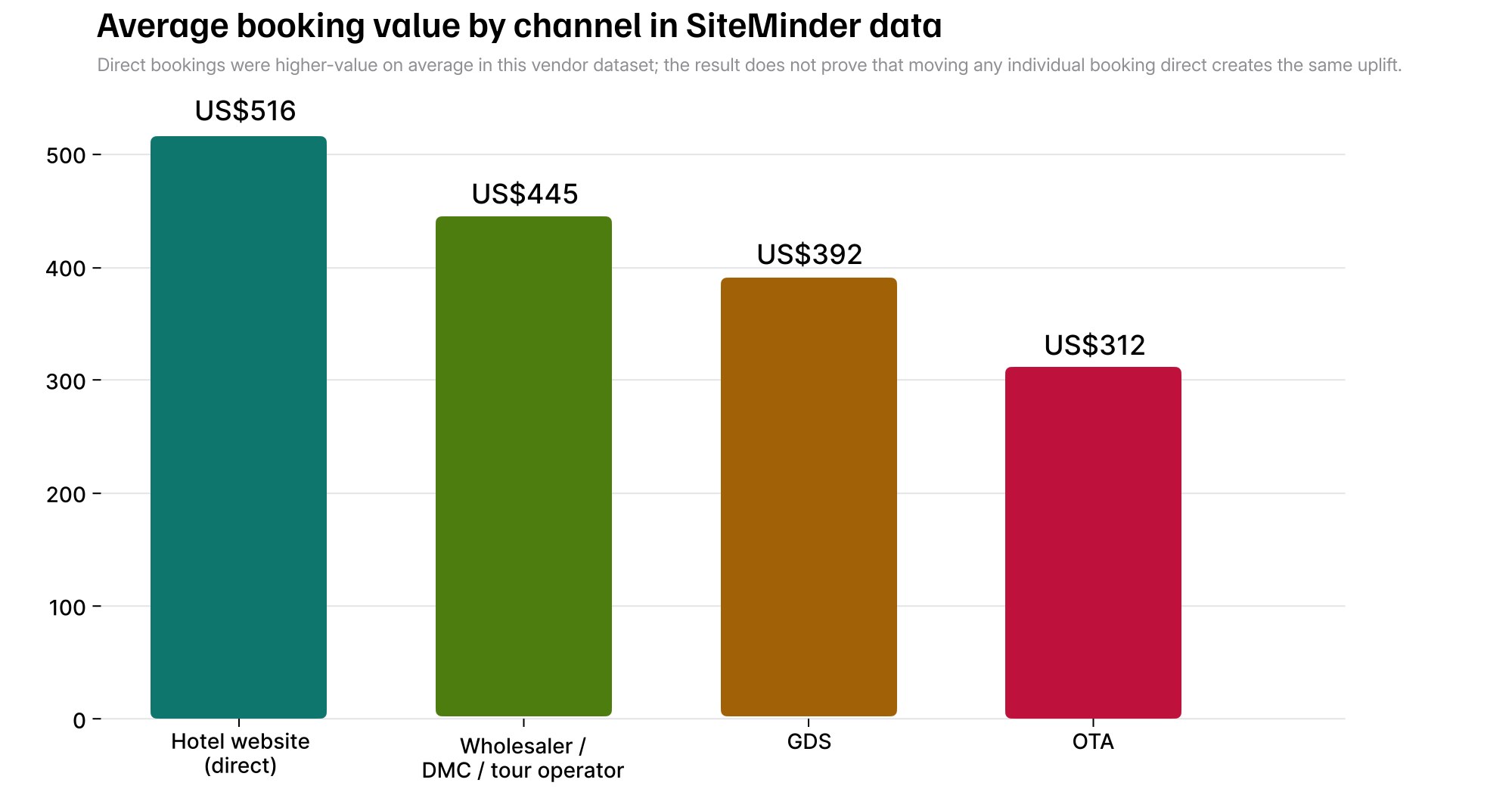
SiteMinder’s 2025 dataset reported an average booking value of US$516 through hotel websites, compared with US$445 through wholesalers, US$392 through GDSs and US$312 through OTAs.[9]
Cloudbeds’ independent-hotel panel reported OTA share at 63.4% and cancellation rates of 21.8% for OTA bookings versus 10.6% for direct bookings.[10]
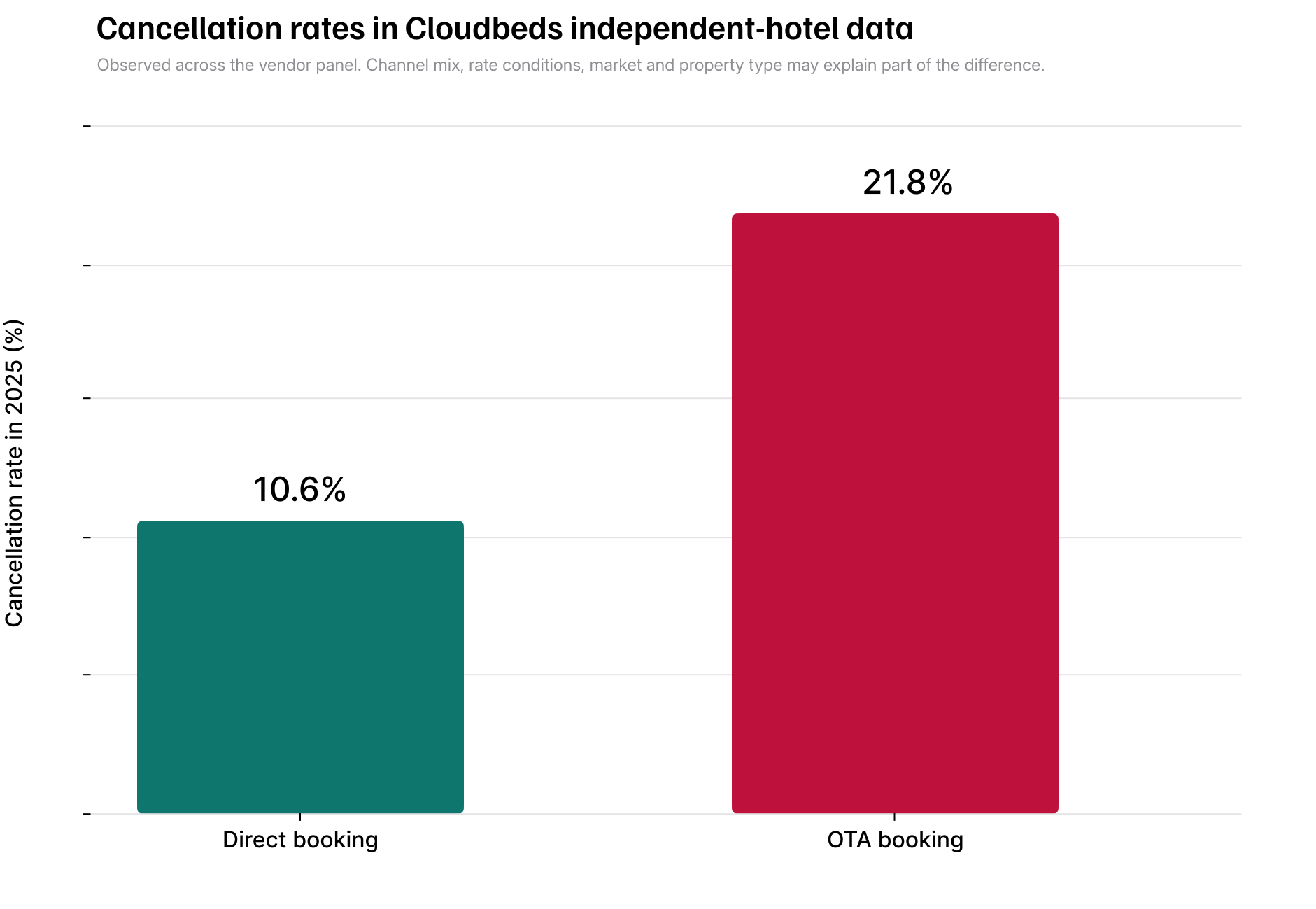
These are vendor datasets, not universal causal estimates. Direct bookings may be higher value because different guests, room types, stay lengths and extras select the direct channel. A property should measure its own net contribution rather than copy the headline.
Direct acquisition can involve:
A commission comparison alone is incomplete.
Experimental research by Lee and Sharma found that price parity can shift preference toward the direct hotel site, while cancellation flexibility and OTA credibility influence choice when offers differ.[11]
This matters for AI-mediated discovery. An AI answer may find the hotel, but the traveler will still compare:
A “book direct” slogan cannot compensate for a worse or less intelligible offer.
The direct channel can carry truth that an OTA listing flattens:
This is a knowledge advantage before it is a pricing advantage.
A direct relationship can support:
These advantages exist only if the property has the process and staff to deliver them.
Two plausible paths coexist.
Direct path: the AI uses OTAs and editorial sources to research, recommends the hotel and links to the official site.
Intermediated path: the AI invokes a connected OTA, completes the transaction inside that ecosystem and leaves the intermediary as merchant, data holder or service owner.
The hotel should therefore track not only mentions, but:
A direct booking journey should make clear:
The commercial objective is not “remove the OTA.” It is “carry more truth and responsibility than the alternative.”
CHAPTER 10
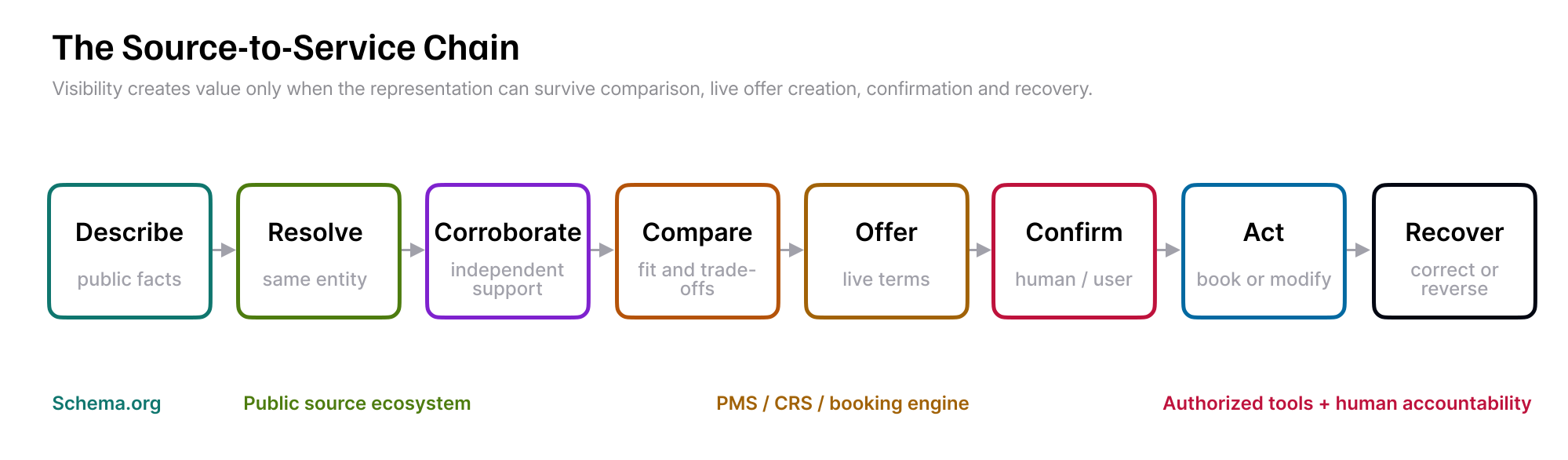
The Source-to-Service Chain has eight steps:
1. Describe - public facts and narrative.
2. Resolve - identify the correct property, room and offer.
3. Corroborate - compare independent and operational evidence.
4. Compare - evaluate fit against the traveler’s constraints.
5. Offer - retrieve live price, availability and rules.
6. Confirm - surface consequential conditions and uncertainty.
7. Act - book, hold, pay or submit a request.
8. Recover - modify, cancel, correct or reach a human.
Visibility creates commercial value only when enough of this chain survives.
HTML and JSON-LD can describe that a Duplex Suite exists and sleeps four. They should not be assumed to prove that it is available on the traveler’s dates.
A price feed or availability API can state that inventory is open. It may still not guarantee a connecting-room request or specific access requirement.
A booking API can create a reservation. It may still fail to provide an understandable recovery path.
Accommodation distribution commonly separates:
Google’s hotel stack likewise separates hotel-list content from rates, availability and inventory mechanisms.[12][13] OpenTravel standards provide mature messages and models for hospitality distribution and transactional handoffs. They complement rather than replace governed source meaning, live system authority, permissions, confirmation, audit and recovery. The web page is one interface among several.
MCP and other agent protocols can expose resources and executable tools. The MCP specification describes tools as model-controlled and recommends user visibility, confirmation and a human in the loop for consequential operations.[14]
An agent-ready hotel service therefore requires more than publishing a server. The tool must be:
For each action, the property should define what a machine may:
For the recurring Chamonix scenario, a system may be able to show live room availability and rate conditions. A human may still need to confirm the exact connected-room allocation or nuanced access fit.
A conservative progression is:
1. expose current facts;
2. retrieve live availability;
3. prepare a quote or booking draft;
4. require explicit human confirmation;
5. execute;
6. support modification and recovery.
The hardest problem is not creating the booking. It is preserving responsibility when the journey changes.
CHAPTER 11
AI answers vary by:
A screenshot is an anecdote. A useful visibility study needs repeated runs, defined prompts, recorded conditions and separate metrics.
Does the system identify the correct property rather than a similarly named hotel?
Does the property enter the considered set for the scenario?
How often is it actually recommended?
Are identity, room, policy, access, season and offer claims correct?
Does the answer preserve conditions such as request-only, seasonal or subject to availability?
Which owned, intermediary, destination, review and editorial sources support the answer?
Is the hotel cited? Where does the link send the traveler?
Does the live price, availability and policy match the booking interface?
Can the traveler complete the intended direct or intermediated action?
Can the traveler correct or reverse it?
Test scenario classes rather than only brand-name prompts:
For each query, record:
“Share of voice” is meaningless unless the prompt universe is defined. A hotel’s visibility for luxury couples in Paris cannot be compared with family ski queries in Chamonix without weighting assumptions.
Publish the prompt panel and weighting, or do not publish a single score.
A hotel with rich schema may also have a stronger brand, better site, more reviews and broader distribution. Observational correlation cannot isolate the effect of markup.
A better test uses staged interventions:
Report what changed and what did not.
AI representation should be connected to:
The purpose is not to prove that AI traffic is valuable. It is to find where the source environment improves or damages the traveler’s decision.
A future full benchmark should audit a defined panel of independent properties across several destination types. For each, it should compare approximately 30 decision-critical facts across owned pages, markup, local profiles, OTAs, destination sources, booking interfaces and repeated AI answers.
This edition provides the method and one forensic case. It does not pretend that one hotel establishes sector prevalence.
CHAPTER 12
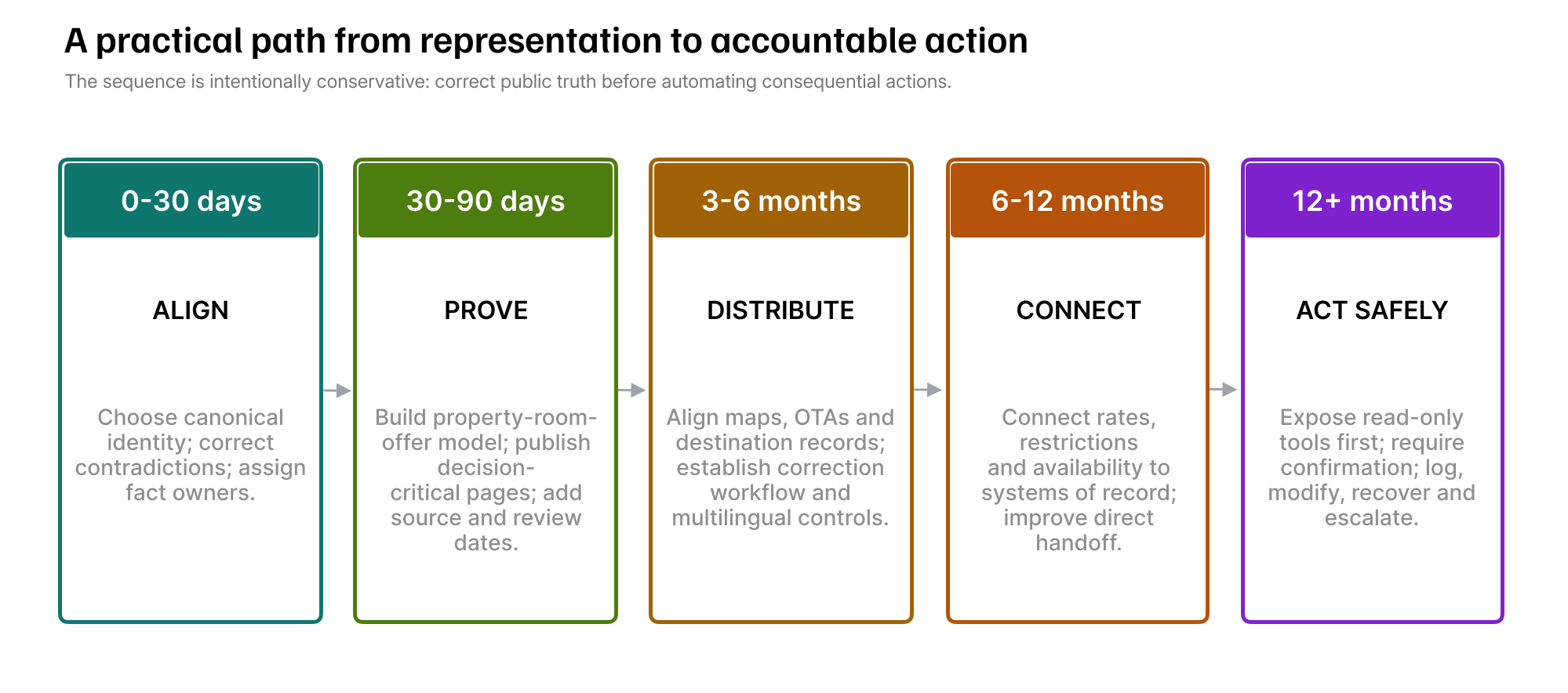
Choose one canonical value and owner for:
Compare the official site, markup, maps, OTAs, destination records and confirmation messages. Correct the highest-risk contradictions first.
A Property Truth Card and propagation map for the first 20-30 facts.
For consequential claims:
A maintained claim and source register, even if it begins as a spreadsheet.
Build coherent public representation:
An Omnichannel Decision Mesh for the highest-value traveler scenarios.
Connect changing facts to their systems of record:
Generate public structured data from governed CMS fields. Use feeds and APIs for live commercial truth rather than manual JSON-LD.
A documented source-to-publication architecture with monitoring.
Begin with read-only capabilities:
Then add:
A bounded Source-to-Service Chain, not an open-ended “AI agent.”
Start with fact ownership, visible decision pages, correct basic markup, channel alignment and a clear human handoff. Do not build a custom knowledge graph or MCP server unless the operational need justifies it.
Standardize identifiers, room and offer models, page templates, multilingual concepts, validation and propagation while preserving property-specific truth.
Maintain canonical local entities, event and transport data, small-business visibility, update rights, media rights and correction channels through a fit-for-purpose destination information system. Publish stable identifiers and documented update responsibilities, but do not overwrite the property’s or transactional system’s authority for live room, rate, restriction, payment or confirmation facts.
Do not label a product “AI-ready” merely because it outputs JSON-LD or adds a chatbot. Demonstrate source ownership, synchronization, action boundaries, auditability and recovery.
Run the original traveler scenario again.
A good answer should state:
That is more meaningful than an abstract visibility score.
CONCLUSION
A modern accommodation property is represented by a network of systems and sources. Its official website is only one version. The booking engine owns a different kind of truth. Structured data makes selected facts explicit. Maps and OTAs aggregate. Destination and editorial sources corroborate. AI systems compress the fragments into an answer.
The versions do not need identical language. They need agreement on consequential facts and clear boundaries around uncertainty.
The evidence reviewed in this paper supports several firm conclusions:
It does not support the claim that a new GEO discipline replaces serious SEO, or that a JSON-LD block automatically creates citation or recommendation.
The more useful ambition is harder:
Make the property’s public story, structured facts, distributed representation, live offer and human service agree. When they agree, machines make fewer guesses. Travelers can see what is confirmed. Direct channels can compete on more than commission. Staff can honour what the digital system promises.
The hotel is not a page.
It is an agreement.
APPENDIX A
Property: Hôtel Mont-Blanc Chamonix. Audit type: public-source forensic review. Primary review period: July 2026. Historical AI snapshot: Gemini report generated December 20, 2025 and reproduced in the Morand-Schegg paper. Structured-data version: third-party proposed JSON-LD from the Morand-Schegg paper; not verified as deployed markup. Direct engine: application interface present; live contents not fully inspectable in the text-only audit.
Precise / confirmed - explicit and supported by the reviewed source.
Partial / generic - present but insufficiently qualified for the decision.
Contradicted / erroneous - conflicts with a stronger current source or is modeled incorrectly.
Not stated / not observable - absent from the reviewed surface or inaccessible to the method.
The official property name is consistently represented by the owned site, Google and OTAs. The proposed JSON-LD uses a variant name that should not become the canonical identity without evidence.
The official site publishes info@hmbchamonix.com. The proposed JSON-LD uses a different address.
Official site, Google and OTAs align on 15:00 check-in and 11:00 checkout. The proposed JSON-LD contains malformed time formatting and a 12:00 checkout value.
The official room page states four people, 75 square meters and two king-size beds. The proposal states a different bed configuration.
The owned site states that Standard and Superior rooms can connect and labels the feature on request. The AI report preserves the availability but does not foreground the request-only condition.
The owned information identifies two adapted Prestige rooms. Google and OTAs use broader labels. None of the reviewed public sources alone resolves the full step-free journey for a specific guest.
Some room pages state 24/7 reception. Expedia frames check-in to midnight and late check-in subject to availability. A traveler should not infer an unconditional guarantee without checking the selected rate and arrival procedure.
The reviewed official restaurant information establishes Sunday lunch. It does not by itself establish a late Sunday dinner for the recurring scenario.
The official site and destination office corroborate the heated outdoor pool and spa. The destination office adds daily opening and minimum age for the spa. Date-specific access and maintenance remain operational questions.
The official site exposes a direct booking path. This study did not perform a live date-specific parity transaction, so it does not claim that the direct rate is cheaper, more flexible or available for the recurring scenario.
The detailed 16-fact by seven-version coding is provided as a companion CSV. The codes are an audit aid, not a quality score.
APPENDIX B
The following pattern demonstrates structure rather than a production-ready deployment. It uses public case facts only where supported and deliberately avoids a live price. In production, values should be generated from governed records and validated against visible content.
{
  "@context": "https://schema.org",
  "@graph": [
    {
      "@type": "Hotel",
      "@id": "https://www.hotelmontblancchamonix.com/#hotel",
      "name": "Hôtel Mont-Blanc Chamonix",
      "url": "https://www.hotelmontblancchamonix.com/",
      "telephone": "+33 4 50 53 05 64",
      "email": "info@hmbchamonix.com",
      "checkinTime": "15:00",
      "checkoutTime": "11:00",
      "address": {
        "@type": "PostalAddress",
        "streetAddress": "62 Allée du Majestic",
        "postalCode": "74400",
        "addressLocality": "Chamonix-Mont-Blanc",
        "addressCountry": "FR"
      },
      "containsPlace": [
        { "@id": "https://www.hotelmontblancchamonix.com/rooms-and-suites/standard-room/#room" },
        { "@id": "https://www.hotelmontblancchamonix.com/rooms-and-suites/duplex-suite/#room" },
        { "@id": "https://www.hotelmontblancchamonix.com/#restaurant" }
      ]
    },
    {
      "@type": ["HotelRoom", "Product"],
      "@id": "https://www.hotelmontblancchamonix.com/rooms-and-suites/standard-room/#room",
      "name": "Standard Room",
      "occupancy": {
        "@type": "QuantitativeValue",
        "value": 2,
        "unitCode": "C62"
      },
      "floorSize": {
        "@type": "QuantitativeValue",
        "value": 19,
        "unitCode": "MTK"
      },
      "description": "Standard and Superior rooms can be connected on request; confirmation is required.",
      "containedInPlace": { "@id": "https://www.hotelmontblancchamonix.com/#hotel" }
    },
    {
      "@type": ["Suite", "Product"],
      "@id": "https://www.hotelmontblancchamonix.com/rooms-and-suites/duplex-suite/#room",
      "name": "Duplex Suite",
      "occupancy": {
        "@type": "QuantitativeValue",
        "value": 4,
        "unitCode": "C62"
      },
      "bed": {
        "@type": "BedDetails",
        "numberOfBeds": 2,
        "typeOfBed": "King-size bed"
      },
      "floorSize": {
        "@type": "QuantitativeValue",
        "value": 75,
        "unitCode": "MTK"
      },
      "containedInPlace": { "@id": "https://www.hotelmontblancchamonix.com/#hotel" }
    },
    {
      "@type": "Restaurant",
      "@id": "https://www.hotelmontblancchamonix.com/#restaurant",
      "name": "Le Matafan",
      "containedInPlace": { "@id": "https://www.hotelmontblancchamonix.com/#hotel" }
    }
  ]
}APPENDIX C
A practical audit should cover at least the following fields.
Official name; canonical URL; property type; operator; brand; address; coordinates; telephone; email; languages.
Room category; occupancy; bed configuration; floor size; connecting relationship; guarantee status; extra-bed policy; cot policy; smoking status; room-level accessibility.
Entrance; lift; adapted room; accessible bathroom; parking; EV charging; station route; shuttle; reception hours; late-arrival procedure.
Restaurant; service days; breakfast; pool; spa; age rules; seasonality; pet policy; room service; concierge; ski storage.
Direct booking URL; room availability; rate plan; total price; taxes; mandatory fees; cancellation; payment; minimum stay; inclusions; member conditions.
Human contact; modification path; cancellation path; refund process; special-request confirmation; after-hours support; correction owner.
APPENDIX D
| Fact type | Visible page | Structured data | CMS / content record | PMS / CRS / feed | API / agent tool | Human confirmation |
|---|---|---|---|---|---|---|
| Property identity | Yes | Yes | System of record | Reference | Read | Rare |
| Room size and beds | Yes | Yes | System of record | Map to inventory | Read | If unusual allocation |
| Connecting rooms | Explain request status | Limited | Capability record | Allocation state | Read / request | Usually yes |
| Check-in / checkout | Yes | Yes | Policy record | Booking rules | Read | Exceptions |
| Restaurant schedule | Yes | Possible | Operational calendar | Optional | Read | Special service |
| Pool operation | Yes | Amenity + conditions where supportable | Operational calendar | Optional | Read | Maintenance / exception |
| Price and availability | Summary only | Only when reliably generated | Reference | System of record | Live read | No, unless exception |
| Cancellation | Selected offer | Offer reference where supported | Policy library | Rate plan | Live read | Edge cases |
| Reservation state | Confirmation only | No public state | Reference | System of record | Authenticated read/write | Consequential changes |
| Accessibility fit | Detailed visible explanation | Selected stable facts | Audited access record | Room mapping | Read | Individual fit often yes |
1. Google Search Central. "AI Features and Your Website." 2026. https://developers.google.com/search/docs/appearance/ai-features
2. Google Search Central. "Introducing Search Generative AI performance reports in Search Console." June 3, 2026. https://developers.google.com/search/blog/2026/06/gen-ai-performance-reports
3. OpenAI. "Publishers and Developers FAQ." 2026. https://help.openai.com/en/articles/12627856
4. Schema.org. "Markup for Hotels." 2026. https://schema.org/docs/hotels.html
5. Nicolas Sitter. "Hotel Schema.org Adoption Study 2026." 2026. https://www.nicolassitter.com/research/hotel-schema-adoption-study-2026
6. Nicolas Sitter. "AI Hotel Landscape 2026." 2026. https://www.nicolassitter.com/research/ai-hotel-landscape-2026
7. Pew Research Center. "Google users are less likely to click on links when an AI summary appears in the results." July 22, 2025. https://www.pewresearch.org/short-reads/2025/07/22/google-users-are-less-likely-to-click-on-links-when-an-ai-summary-appears-in-the-results/
8. Adobe. "AI travel traffic surges as engagement hits new highs." June 2026. https://business.adobe.com/uk/blog/adobe-report-ai-traffic-travel-sites-surges-200-percent
9. SiteMinder. "Hotel Booking Trends 2026." 2026. https://www.siteminder.com/hotel-booking-trends/
10. Cloudbeds. "The 2026 State of Independent Hotels." 2026. https://www.cloudbeds.com/hospitality-industry-report/
11. Lee, S. W., and Sharma, A. "Beyond rate parity: Examining offer uniqueness and channel credibility in hotel pricing." Tourism Economics 31(2), 2025. https://doi.org/10.1177/13548166241273881
12. Google for Developers. "Hotel List Feed." https://developers.google.com/hotels/hotel-prices/xml-reference/hotel-list-feed
13. Google for Developers. "Availability, Rates, and Inventory (ARI) Overview." https://developers.google.com/hotels/hotel-prices/xml-reference/ari-overview
14. Model Context Protocol. "Tools." https://modelcontextprotocol.io/specification/2024-11-05/server/tools
15. Laurent Bourrelly. "Formation Cocon Sémantique." https://www.laurentbourrelly.com/blog/boutique/cocon-semantique
16. Laurent Bourrelly. "Cocon Sémantique OmniCanal." https://www.laurentbourrelly.com/blog/boutique/cocon-semantique-omnicanal
17. Christian Méline. "Définitions - Métamots, lexies et signature sémantique." https://seo.metamots.xyz/cours-1-semantique-seo-definitions/
18. Christian Méline. "Cocon sémantique et glissement sémantique." https://seo.metamots.xyz/
19. Hôtel Mont-Blanc Chamonix. "Winter Practical Information." Accessed July 2026. https://en.hotelmontblancchamonix.com/winter/information
20. Hôtel Mont-Blanc Chamonix. "Standard Rooms." Accessed July 2026. https://en.hotelmontblancchamonix.com/rooms-and-suites/standard-room
21. Hôtel Mont-Blanc Chamonix. "Duplex Suites." Accessed July 2026. https://en.hotelmontblancchamonix.com/rooms-and-suites/duplex-suite
22. Hôtel Mont-Blanc Chamonix. "Spa by Clarins." Accessed July 2026. https://en.hotelmontblancchamonix.com/summer/spa
23. Hôtel Mont-Blanc Chamonix. "Le Matafan / Restaurant information." Accessed July 2026. https://en.hotelmontblancchamonix.com/
24. Hôtel Mont-Blanc Chamonix. Official website. https://www.hotelmontblancchamonix.com/
25. Hôtel Mont-Blanc Chamonix. Direct booking application. Accessed July 2026 via the official website.
26. Google Hotels. "Hôtel Mont-Blanc." Accessed July 2026. https://www.google.com/travel/hotels/entity/CgsItL-rwM_ZgPiOARAB
27. Booking.com. "Hôtel Mont-Blanc Chamonix." Accessed July 2026. https://www.booking.com/
28. Expedia. "Hôtel Mont Blanc Chamonix." Accessed July 2026. https://www.expedia.com/Chamonix-Mont-Blanc-Hotels-Hotel-Mont-Blanc-Chamonix.h425247.Hotel-Information
29. Chamonix-Mont-Blanc Tourist Office. "Spa by Clarins Hôtel Mont-Blanc." Accessed July 2026. https://en.chamonix.com/en-cas-de-mauvais-temps/spa-by-clarins-hotel-mont-blanc
30. Chamonix-Mont-Blanc Tourist Office. Accommodation and pool listings. Accessed July 2026. https://en.chamonix.com/
31. Morand, Jean-Claude, and Schegg, Roland. Be Visible to AI: The Keys to Semantic Optimization and GEO (Generative Engine Optimization) for Hotels: Focus on Advanced Structured Data Strategies. Version 5.1, August 19, 2026. Zenodo, published August 22, 2026. https://doi.org/10.5281/zenodo.22059150
32. Ibid., proposed Hôtel Mont-Blanc JSON-LD case, pp. 44-47.
33. Ibid., Gemini Pro family-hotel report appendix, pp. 60-74.
34. Google Search Central. "A new resource for optimizing for generative AI in Google Search." May 15, 2026. https://developers.google.com/search/blog/2026/05/a-new-resource-for-optimizing
35. Schema.org. "HotelRoom." 2026. https://schema.org/HotelRoom
36. Nicolas Sitter. "The ChatGPT Direct-Traffic Explosion for Hotels." May 2026. https://www.nicolassitter.com/research/chatgpt-hotel-direct-traffic-explosion-2026
Tamaga is a travel knowledge infrastructure company. It helps travel organizations structure what they know, prove what they claim, and build platforms that can be discovered, trusted, cited, updated, translated and operated.
Clearer sources for better travel.

The paper compares public representations and documents the evidence boundary for each observation.