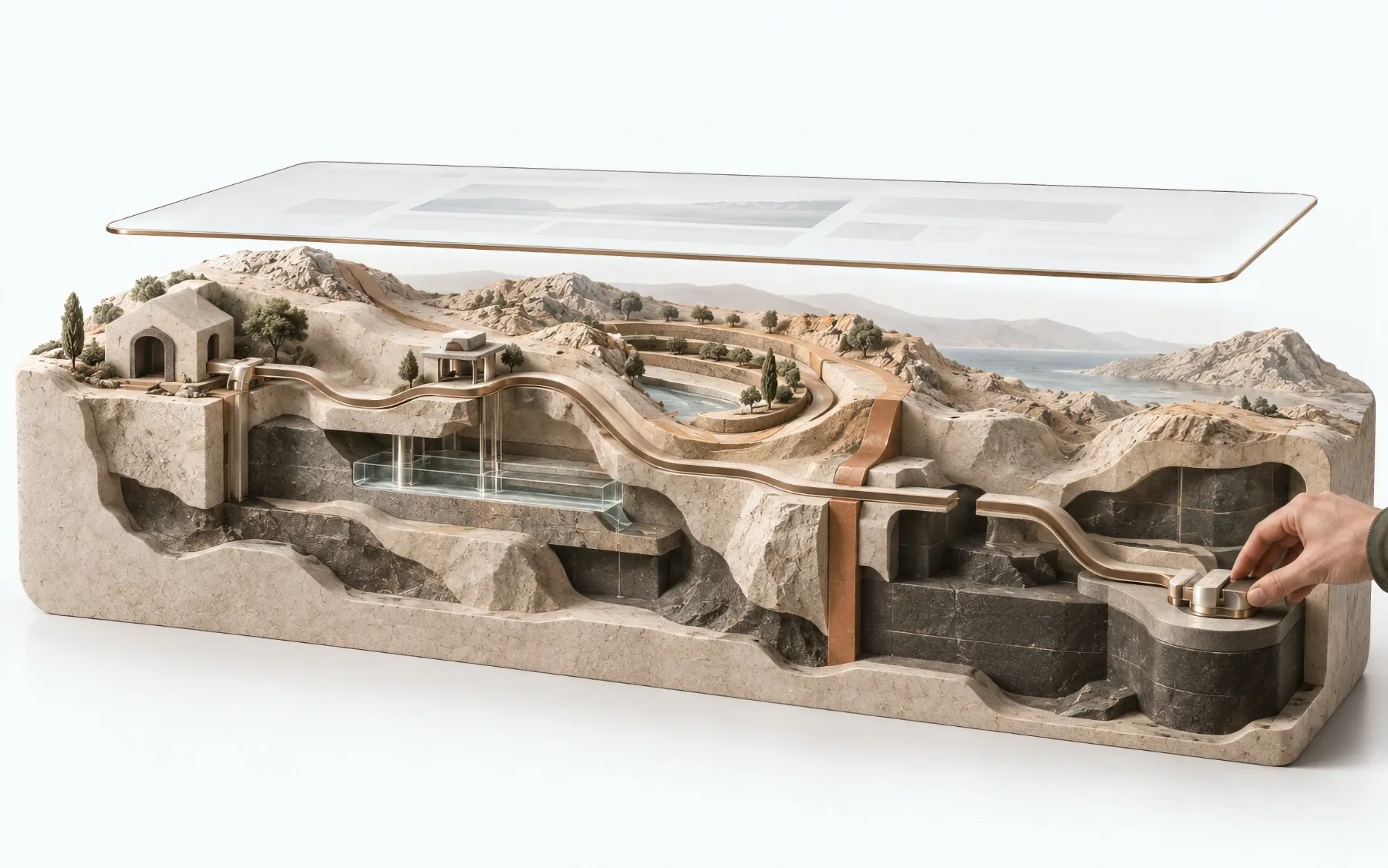
The system underneath the travel website
A traveller with a confirmed room expects to arrive at 23:30 and asks a simple question:
Can I arrive late?
The public page says late check-in is available.
The house rule says:
Arrival after 20:00 requires written confirmation.
The room is booked. The arrival is not.
Nothing here has to be false. But possible has started to sound like confirmed.
This is a synthetic Tamaga Hotel situation, used to expose a kind of decision failure. The page can be correct while the traveller still lacks a clear condition, authority, or next action.
Something underneath the page has to remember what the sentence means, where it came from, when it applies, who is allowed to establish the answer, and what must happen when somebody relies on it.
This is the layer Tamaga calls travel knowledge infrastructure.
Travel knowledge infrastructure is the governed system that keeps what a travel organization means, knows, can prove, and must do connected as that knowledge moves between people, pages, platforms, and machines.
Or, more simply:
It is the system underneath the travel website.
The website is a view of the knowledge
A website still matters.
It may be the richest first-party explanation of a hotel, route, destination, room, season, or promise. It gives an organization somewhere to explain itself carefully, show the limits of an answer, and correct what has changed.
But the website is not the whole knowledge system.
Behind one travel page may sit:
- a person who knows the exception;
- a source document that establishes the fact;
- a content model that stores it;
- a booking system that owns availability or reservation state;
- a partner who must confirm something;
- a translation that may change the strength of the sentence;
- structured data that represents part of it;
- an operational state that changes after the page was published;
- another platform that shortens it;
- a correction that still has to travel.
The mistake is not that these things are separate. They often should be separate.
The mistake is assuming that one of them owns every kind of answer.
Live inventory may belong to a booking authority. A room limitation may belong to the House. A transfer may depend on an external provider. A late-arrival request may remain pending until a responsible person confirms it.
Travel knowledge infrastructure does not create one enormous source of truth. It creates an authority map around the knowledge.
Why travel needs this category
Travel knowledge has a character that makes it difficult to freeze into pages or fields.
It is relational. A room, route, or partner means something different in relation to a particular journey.
It is conditional. Late arrival may be possible if somebody confirms it. A transfer may exist if the provider accepts the timing. A room may fit one party and not another.
It is seasonal. The same road, facility, landscape, or promise can be generous in May and wrong in August.
It is distributed. Hosts, guides, operators, destinations, booking systems, partners, and platforms each know different parts.
It is physical. Eventually somebody reaches a door, road, border, museum, restaurant, or mountain pass.
It is operational. The answer may create work for another human: confirm, prepare, warn, decline, reroute, or correct.
It is alive. A road changes. A partner changes. A rule changes. The page may not.
That is why this is more than a collection of pages.
A hotel asks whether late arrival has actually been confirmed.
A DMC asks whether yesterday’s route advice still applies after rain.
A destination asks who can correct a local-business record that appears in several public systems.
A cultural route asks which source supports a heritage statement copied into four languages.
These are different situations. They share the same infrastructure questions:
What does this mean?
Where did it come from?
Who can establish it?
How is it represented?
What happens when somebody relies on it?
The examples in this section are illustrative category examples, not reports of live client systems or measured market frequency.
Two faces and one edge
One way Tamaga thinks about the problem is as a coin.
One face is meaning for people.
It includes:
- what the organization wants to be understood for;
- what the traveller is trying to decide;
- the concepts and language needed to understand the answer;
- the context, limitation, or omission that keeps the answer honest.
The other face is meaning for machines.
It includes:
- entities and stable identities;
- relationships between places, rooms, routes, offers, partners, seasons, and claims;
- content models;
- structured data;
- APIs and other machine-readable representations;
- explicit states that software can interpret.
The edge is authority.
Authority records where a claim came from, who owns it, under which condition it applies, what state it is in, when it was reviewed, and who or what is allowed to establish the next answer.
Without that edge, the two faces can drift apart.
A machine-readable statement can remain technically valid while a condition disappears.
A carefully written page can be outdated.
An AI answer can be fluent without being authorized.
A booking request can exist without being confirmed.
The job is not to make every representation identical. The job is to preserve the distinctions that become consequential.
The coin is a Tamaga conceptual model. It is not a claim that every organization already has a complete implementation of this system.
A page, an entity, and an answer are different things
Take one room.
For a traveller, it may mean:
Will this actually work for us?
For a content system, it may be an entity with beds, access characteristics, images, occupancy, and relationships.
For Schema.org, some of those facts may become public machine-readable statements.
For the booking engine, the immediate question may be whether that room type can still be sold on those dates.
For the host, the remaining question may be whether an exception can be accepted.
All of these can describe the same stay without being the same authority.
That is why structured data matters, but cannot carry the whole category.
Structured data makes selected meaning machine-readable. It does not become operational authority merely because it validates.
The same is true of AI output.
An AI system may locate, compare, summarize, or rephrase knowledge. Its output does not become the source merely because it sounds complete.
A claim still needs provenance.
A condition still needs scope.
A request still needs a state.
A consequential decision still needs authority.
Semantic architecture is one method, not the category
Semantic architecture is one method Tamaga uses to build this infrastructure. It defines entities, relationships, concepts, decision paths, and authority before pages and integrations harden around them.
Travel knowledge infrastructure names the system being built. Semantic architecture describes part of how Tamaga reasons about and constructs it.
The distinction matters because the problem does not belong to developers alone. A hotel owner maintaining an arrival promise, a destination manager governing partner records, a marketer working with seasonal language, and a developer designing an entity model may all be touching the same knowledge system from different positions.
The category is wider than the current proving ground
Hospitality makes the problem unusually visible because a public sentence can quickly become a physical expectation.
But travel knowledge infrastructure is not a synonym for hotel software.
It can also describe the governed layer around a route, a destination, a DMC, a partner network, a cultural itinerary, or a multilingual place record.
Tamaga Hospitality is currently Tamaga’s commercial focus and first productized system. The wider travel knowledge infrastructure category describes a broader method and field of application; this page does not present every wider application as a released Tamaga product.
Four things every consequential travel answer needs
Before adding another page, integration, or AI layer, take one important traveller question and trace four things.
1. Meaning
What does the traveller actually need to understand?
Not merely the field value. The condition, limitation, and context that make it useful.
2. Representation
Where does that meaning appear?
Website, booking path, structured data, API, listing, translation, message, or synthesized answer.
Different representations may legitimately carry different amounts of information.
3. Authority
Who or what is allowed to establish the answer?
A host, guide, partner, booking authority, payment provider, official source, or another named system.
4. Action
What happens when somebody relies on it?
Book.
Request.
Confirm.
Decline.
Escalate.
Review.
Correct.
Or say:
We do not know yet.
That last answer is not necessarily a failure of infrastructure. Sometimes it is evidence that the infrastructure is behaving honestly.
Try it on one decision
Choose one sentence a traveller could act on.
For example:
Arrival after 20:00 requires written confirmation.
Then trace it:
| Meaning | Representation | Authority | Next action |
|---|---|---|---|
| Late arrival may be possible, but it is conditional. | Website, booking path, message, and structured data where appropriate. | Responsible property operator or authorized operational system. | Keep the request pending until it is confirmed or declined. |
Now remove one column.
If the system still looks safe, ask why.
If it suddenly becomes ambiguous, you have probably found the part of the knowledge infrastructure that matters.
The next travel internet will not become better simply because it publishes more pages or generates more answers.
It will become better when the organizations closest to the knowledge can keep its meaning, evidence, authority, and consequences intact as that knowledge travels.
The website remains part of the answer. It is simply the visible surface.
Scope and status
Travel knowledge infrastructure is a Tamaga category definition. It is not presented here as an established industry standard.
The opening Tamaga Hotel situation is synthetic and illustrative. It does not report a live guest, reservation, property outcome, client result, or measured market frequency.
Tamaga Hospitality is currently Tamaga’s commercial focus. Broader tourism applications discussed here describe the category and the direction of the method; they should not be interpreted as a list of released products.
Last reviewed: 7 September 2026
Correction state: No corrections recorded at publication time.